Best Times to Post on Facebook for Maximum Reach in 2026: A Beginner's Guide
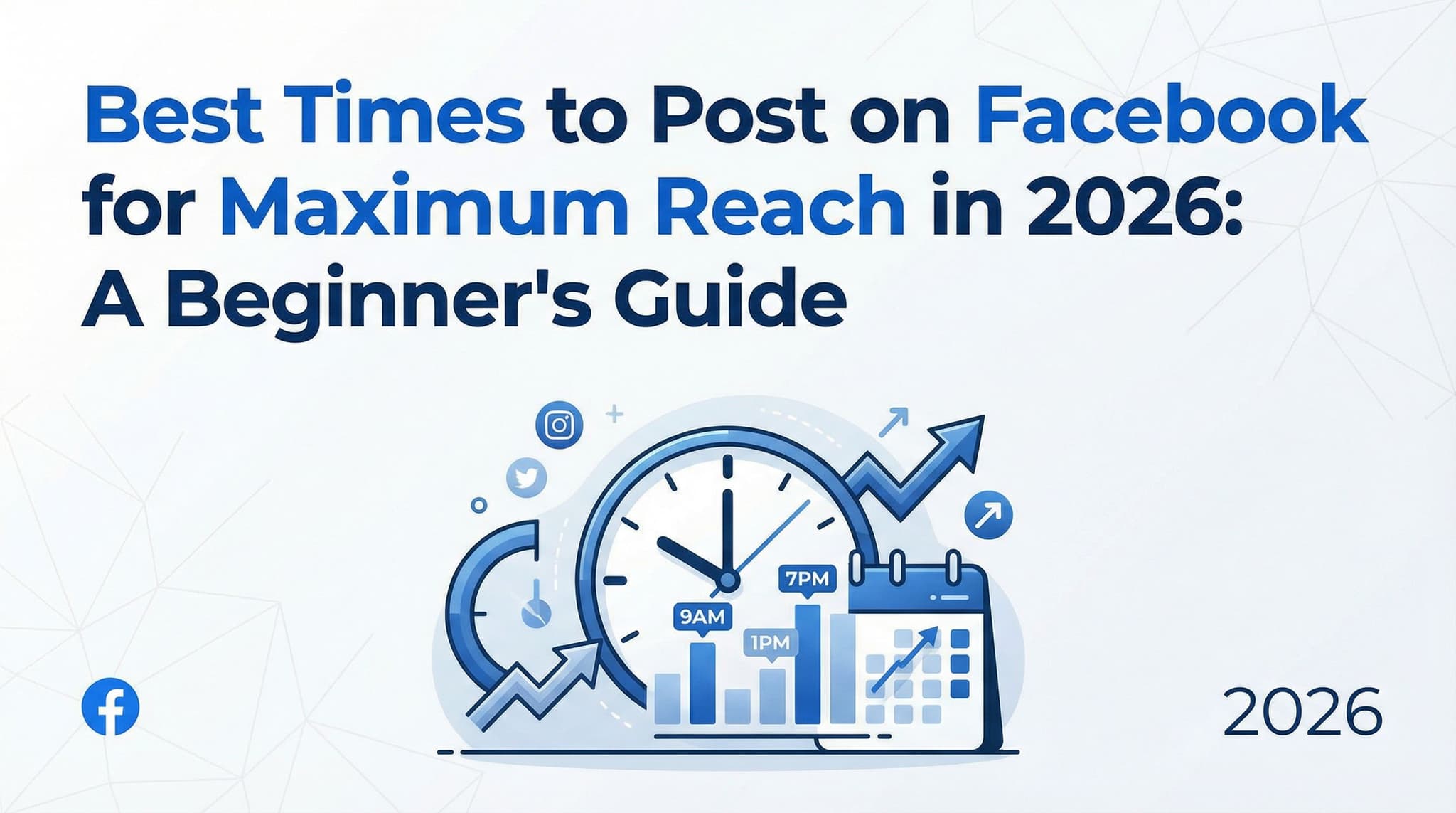
Let's be honest: there's a lot of confusing advice out there about when to post on Facebook. One article tells you Tuesday at 2 PM is golden. Another swears by Saturday mornings. A third insists evening is where it's at. So which one is right? Here's the truth nobody wants to admit—they might all be wrong for your business.
The reality is far more nuanced than a one-size-fits-all posting schedule. Your optimal posting time depends on who your audience is, what industry you're in, where they live, and what type of content you're sharing. A B2B consultant targeting corporate executives has completely different audience behavior patterns than a lifestyle brand posting weekend inspiration content.
The good news? You don't need expensive analytics tools or a social media degree to figure this out. Facebook gives you powerful insights right inside your business page—insights that most beginners completely overlook. In this guide, we're going to walk through exactly how to discover when YOUR specific audience is most active, test different posting times, and build a posting strategy that actually works. Let's dive in.
Understanding the Foundation: Why There's No Universal 'Best Time'
Before we jump into specific times and strategies, we need to address the elephant in the room: the idea that there's one perfect time to post on Facebook for everyone is fundamentally flawed. This misconception has probably led you down rabbit holes of conflicting advice, testing tactics that didn't work for your business, and frustration when you couldn't replicate someone else's success.
The truth is that posting performance on Facebook is influenced by dozens of variables, and each business operates in a unique combination of these factors. Your audience's behavior is shaped by their professional obligations, leisure habits, geographic location, and personal preferences. A manufacturing company's employees might be checking Facebook during lunch breaks on weekdays, while a fitness brand's followers are scrolling through content Saturday morning while sipping coffee before their workout class.
What makes this even more complicated is that Facebook's algorithm has evolved significantly. In 2026, the platform prioritizes content quality, relevance, and meaningful engagement far more than it did in previous years. This means that even if you post at the statistically optimal time, a mediocre post will underperform compared to a high-quality post shared at a less-than-ideal time. The algorithm is designed to show people content they actually care about, not just content from their friends and pages they follow.
Understanding this foundation changes how you should approach your Facebook strategy. Instead of obsessing over finding the one magic posting time, you should be thinking about creating a personalized posting schedule based on YOUR audience's specific behavior patterns. This is where things get exciting, because you have all the data you need to do this right now.
1. Why Industry and Audience Demographics Matter More Than You Think
The first variable that dramatically affects optimal posting times is your industry and audience demographics. Think about the difference between a B2B SaaS company and a direct-to-consumer fashion brand. The B2B company's audience consists of business professionals who check Facebook during work hours, often during breaks or between meetings. The fashion brand's audience includes students, stay-at-home parents, and professionals of all types who might be scrolling during completely different times.
Age demographics play a massive role too. Younger audiences (Gen Z and younger millennials) have different Facebook usage patterns than older generations. While this might seem counterintuitive—many assume younger people have abandoned Facebook entirely—the reality is that younger users who ARE on Facebook tend to be active during evening hours and late night, while older demographics often show stronger engagement during daytime hours.
Professional fields create predictable patterns. Healthcare workers might have limited phone access during shifts. Retail employees might have their busiest personal browsing time during evening hours after work. Teachers have natural engagement windows during lunch breaks and after school. Instead of trying to apply generic advice, you need to think about your specific audience's lifestyle and when they realistically have time to engage with social media.
2. Geographic Location: The Time Zone Challenge
Here's a challenge that many beginner content creators don't consider until they start experiencing it: geographic distribution. If your audience is concentrated in one city or region, you can focus on that local time zone. But if you're serving customers across multiple states, multiple countries, or even multiple continents, timing becomes exponentially more complex.
A small business owner in New York serving clients nationwide faces a real dilemma. A post published at 2 PM Eastern Time hits the sweet spot for East Coast viewers but might be 11 AM on the West Coast (still morning for many) or 1 PM Central (solid engagement time). You can't optimize for all time zones simultaneously with a single post. This is why many businesses with geographically dispersed audiences eventually adopt a multi-posting strategy or choose times that represent a reasonable compromise across their key markets.
Some businesses solve this by analyzing where their actual engagement comes from using Facebook Insights. If 60% of your audience is in Eastern Time and 30% is in Central Time, you might prioritize Eastern Time for your main posts. Others use scheduling tools to post the same content multiple times at different times to catch different time zones. The key is being intentional about it rather than posting randomly and hoping for the best.
The Data-Driven Approach: Using Facebook Insights to Find Your Sweet Spot
Now we get to the part that actually changes everything—the part where you stop guessing and start knowing. Facebook Insights is a free analytics tool built directly into your Facebook business page, and it contains everything you need to identify when your specific audience is most active. Most beginners either don't know it exists or don't understand how to use it effectively. This is your competitive advantage.
To access Facebook Insights, go to your business page, click on the "Insights" tab in the left menu, and you'll see an overview of your page performance. But the real magic happens when you dig deeper into the "Posts" section and look at the "When Your Audience Is Online" data. This shows you exactly when your followers are on Facebook, broken down by day of the week and hour of the day. This isn't guesswork—this is actual data from your actual followers.
What you're looking for is patterns. You might notice that your audience shows a spike every Tuesday from 1-3 PM, another spike on Thursday evenings, and a smaller but consistent spike Saturday mornings. These patterns are your personalized posting schedule. Different from what the generic articles say? That's exactly the point. Your data matters infinitely more than generic advice.
The beauty of this approach is that it's completely free, it's specific to your audience, and it updates continuously as your follower base grows and evolves. You're not relying on case studies from other businesses or industry benchmarks—you're using actual data from the people who follow your page right now.
3. Analyzing Your Insights: From Data to Action
Once you've found your audience activity data in Facebook Insights, the next step is translating that information into an actual posting schedule. Here's a practical framework: identify your top three activity windows. These might be Tuesday 1-3 PM, Thursday 2-4 PM, and Saturday 9-11 AM. Write these down. These are your primary posting times.
Next, look at your historical post performance. In the Posts section of Insights, you can see each individual post you've published, along with metrics like reach, engagement, and clicks. Start paying attention to which of your posts got the best performance and what time they were posted. You might discover that even within your peak activity windows, certain times perform better than others, or that certain types of content perform better at certain times.
Create a simple spreadsheet tracking your posting times and performance. Include the date posted, time posted, content type, reach, engagement, and any notes about what was happening that day. After 4-6 weeks of data collection, patterns will emerge. Maybe you'll notice that your Tuesday posts consistently outperform your Wednesday posts, even though both fall within your audience's peak activity window. Maybe video content performs better in evenings while text posts perform better during work hours. This granular data becomes your personalized playbook.
4. Specific Timing Patterns: B2B vs. B2C Behavior
While we've established that there's no universal best time, certain patterns do emerge consistently across different business models. Understanding these baseline patterns gives you a starting point before you customize based on your specific audience data.
For B2B content—posts targeting business professionals, companies, or corporate decision-makers—weekday afternoons consistently generate higher engagement. Specifically, Tuesday through Thursday afternoons (roughly 1-3 PM) show strong performance across most B2B industries. Why? Because professionals are checking Facebook during their workday, often during lunch breaks or brief breaks between meetings and calls. They're in work mode, so professional content resonates. This pattern holds true even as remote work has become more common, because professionals still have predictable work schedules and break times.
B2C, lifestyle, and entertainment content shows a completely different pattern. Weekend mornings (Saturday and Sunday, 8-10 AM) typically outperform weekday posting for these content types. Why? Because people engage with lifestyle and entertainment content during their leisure time. Saturday morning, many people are relaxed, have time to browse, and are in a mindset open to inspiration, entertainment, and lifestyle content. This is when someone is most likely to engage with a fitness brand's motivational post, a fashion brand's new collection, or a travel company's destination inspiration.
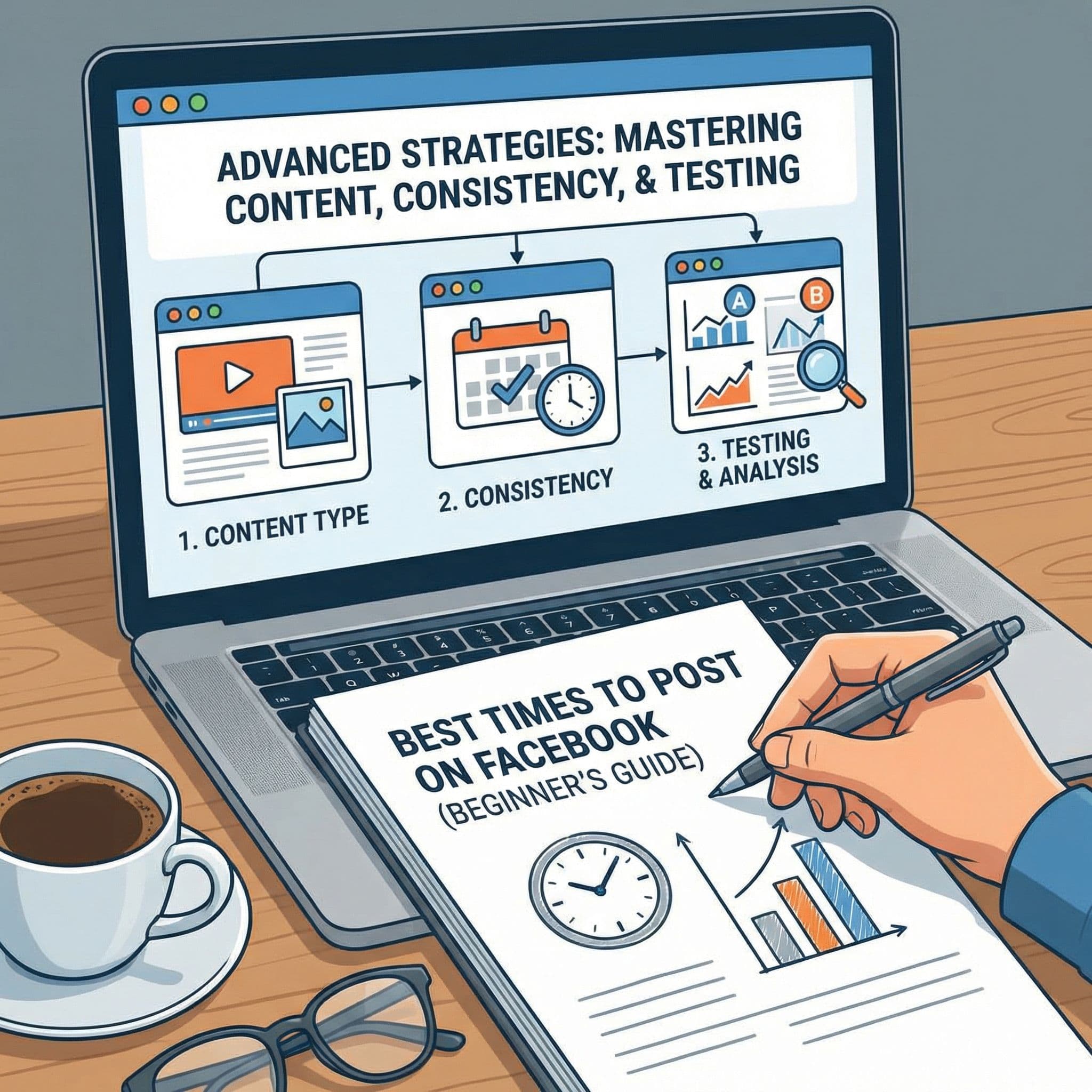
Advanced Strategies: Mastering Content Type, Consistency, and Testing
Now that you understand the fundamentals, let's talk about the strategies that separate successful Facebook marketers from those who struggle. These aren't complicated tactics—they're actually quite straightforward—but they require intention and consistency to implement.
The first strategy is recognizing that different content formats have different optimal times. Feed posts, Stories, Reels, and video all have their own patterns. This is crucial information that many beginners miss because they treat all content the same. A long-form carousel post might perform best during work hours when people have time to engage with longer content. A short, entertaining Reel might perform best in the evening when people are winding down. A Story might get the most views during commute times (morning and evening) when people are scrolling quickly through ephemeral content.
The second strategy is understanding that posting frequency and consistency matter far more than hitting the perfect time with mediocre content. A consistently good post shared at a slightly suboptimal time will almost always outperform a mediocre post shared at the perfect time. This is because of how Facebook's algorithm works—it prioritizes content that gets immediate engagement and meaningful interaction. If your content is compelling, people will engage with it regardless of whether it was posted at 1:47 PM or 2:15 PM.
The third strategy is building a systematic testing methodology. Instead of randomly experimenting, create intentional tests. Pick one variable to test at a time—maybe time of day—and keep everything else constant. Test the same type of content, similar messaging, similar quality, but at different times. Run each test for at least 2-3 weeks to account for weekly variations. Track the results. This scientific approach removes guesswork and builds a personal knowledge base that grows more valuable over time.
5. Video Content: The Evening Advantage
Video content deserves special attention because it performs differently than other content types on Facebook. While your overall audience might show peak activity during work hours, video content consistently performs better during evening hours (roughly 6-9 PM). This is because video requires more time and attention than a quick text post or image. People watch video during their leisure time, not during work breaks.
Think about your own behavior. During work, you might quickly scroll through text posts or images between tasks. But when you settle in at night, you're more likely to actually watch a video from start to finish. You have time for it. You're relaxed. You're not multitasking as much. This behavior is consistent across demographics and industries.
This creates an interesting optimization opportunity: if your primary posting time based on audience activity is 2 PM, but you're primarily publishing video content, you might want to test shifting that to 6 PM or 7 PM. You might find that your 6 PM videos get better watch time, shares, and comments than your 2 PM videos, even though fewer people are online at 6 PM. This is because the people who ARE online at 6 PM are more engaged with video content.
The practical application: track whether your video content performs better at different times than your other content. If you notice video consistently outperforms at evening times, make evening your primary posting time for video while potentially keeping afternoon times for other content types. This nuanced approach beats applying a blanket posting schedule to all your content.
6. Stories and Reels: Different Rules for Different Formats
Stories and Reels have fundamentally different engagement patterns than traditional feed posts, and treating them with the same posting schedule will leave engagement on the table. Stories are ephemeral—they disappear after 24 hours—and they're designed for frequent, casual sharing. Reels are short, entertaining video content that Facebook actively promotes in its algorithm. Both deserve their own timing strategy.
Stories perform best during high-traffic times when people are actively browsing. Morning commute times (7-9 AM), lunch hours (12-1 PM), and evening wind-down times (6-8 PM) show strong Story engagement. Because Stories are quick to consume and disappear quickly, people engage with them during moments of casual browsing. If you're posting Stories, you might post more frequently throughout the day, hitting these multiple peak times, rather than posting once at your optimal time.
Reels, on the other hand, are algorithmically promoted by Facebook as a TikTok competitor. They perform well during leisure time, similar to video, but they also have their own algorithm boost that can carry them beyond just your follower base. This means Reels can perform well even at times that aren't your peak audience activity. Many successful content creators post Reels in the evening (6-9 PM) specifically because people engage with them more during leisure time, and the algorithm boost helps them reach beyond just your immediate followers.
The practical takeaway: if you're using multiple content formats, don't apply the same posting schedule to all of them. Stories might get three posts throughout the day at different peak times. Feed posts might get one post at your optimal afternoon time. Reels might get one post in the evening. This multi-format approach maximizes engagement across all your content types.
7. The Quality-Over-Timing Principle and Consistent Posting
Here's a hard truth that will actually make your Facebook marketing easier: a great post at a mediocre time beats a mediocre post at the perfect time almost every single time. This is because of how Facebook's algorithm works in 2026. The algorithm is designed to show people content they'll actually engage with. If your post is compelling, well-written, visually appealing, and relevant to your audience, people will engage with it. If your post is boring, poorly written, or irrelevant, people will scroll past it regardless of when it was posted.
This changes how you should prioritize your efforts. Instead of obsessing over whether 2 PM or 3 PM is better, invest that mental energy in creating genuinely good content. A well-researched blog post shared on your page, a beautiful product photo with engaging copy, a video that actually teaches something or entertains—these things drive engagement far more than posting timing.
Equally important is consistency. Posting regularly—whether that's three times a week or once daily—trains your audience to expect your content and builds momentum. The algorithm favors pages that post consistently because it signals that the page is active and regularly producing content. If you post sporadically, even if each post is perfect, you'll get less overall reach than if you post consistently with slightly less perfect posts.
The practical framework: aim for consistent posting at times you've identified as good for your audience. The quality of the content matters far more than the exact minute you post. If your best time is 1-3 PM on Tuesday but you're not ready with great content until 3:30 PM, post at 3:30 PM. The slight timing miss is less damaging than delaying good content or posting mediocre content to hit the time.
8. A/B Testing: The Scientific Approach to Finding Your Optimal Schedule
A/B testing is simply comparing two versions of something to see which performs better. When applied to posting times, it's one of the most powerful ways to remove guesswork from your Facebook strategy. Most beginners don't do this because they think it's complicated. It's actually quite simple, and Facebook makes it easier than you'd expect.
Here's how to run a basic posting time A/B test: Choose one type of content you post regularly (let's say motivational quotes if you're a coach, or product photos if you're an e-commerce business). For the next three weeks, post this content at time A (let's say 2 PM Tuesday). For the following three weeks, post the same type of content at time B (let's say 7 PM Tuesday). Keep everything else identical—the content quality, the copy style, the visual style, everything. Only change the time.
After each three-week period, review your Facebook Insights. Look at the average reach, engagement rate, and clicks for each time slot. Which one performed better? That's your answer for that content type. Now you can test another variable. Maybe next month you test Wednesday vs. Thursday. Maybe you test morning vs. afternoon. Each test builds your personal knowledge base.
The key to successful A/B testing is patience and isolation of variables. Test one thing at a time. Run tests for at least 2-3 weeks to account for weekly variations. Track your results systematically. Over time, you'll develop a clear picture of what works specifically for your audience, which is infinitely more valuable than any generic advice.
9. Algorithm Reality Check: Content Quality and Relevance Trump Timing
Before we wrap up, let's address something that's changed significantly on Facebook in recent years: the algorithm's evolution. In the early days of Facebook marketing, posting time was perhaps more critical than it is today. The algorithm was simpler, and timing played a larger role in determining visibility. That's not the case in 2026.
Today's Facebook algorithm is sophisticated. It learns from user behavior at scale. It notices which posts individual users engage with, which pages they interact with most, which types of content hold their attention. It then shows each person a personalized feed designed to maximize their engagement and time on the platform. In this system, posting time matters, but it's far from the most important factor.
What matters most is content quality and relevance. A post that genuinely resonates with your audience—that makes them stop scrolling, that makes them want to comment, that makes them want to share—will get more reach and engagement than a mediocre post posted at the perfect time. The algorithm sees that engagement and boosts the post. It shows it to more people. It prioritizes it in feeds.
This is actually liberating news for small business owners. It means you don't need to obsess over posting at exactly 2:47 PM. It means you can focus on creating content that your audience actually cares about. It means quality and consistency matter more than perfection. The algorithm will reward good content with good reach, regardless of whether it was posted at 2 PM or 2:30 PM. This takes a lot of pressure off and lets you focus on what really matters—creating content worth engaging with.
10. Geographic Distribution and Time Zone Strategy
If you serve a geographically dispersed audience, time zone management becomes a central part of your posting strategy. This is a real challenge that many growing businesses face, and there's no perfect solution, but there are smart ways to handle it.
First, analyze your audience distribution using Facebook Insights. Go to Insights, click on "People," and look at "Top Countries" and "Top Cities." This shows you where your followers are located. If you see that 50% are in Eastern Time, 30% are in Central Time, and 20% are in Pacific Time, you now have data to work with.
Your options are: (1) optimize for your largest time zone, (2) choose compromise times that work reasonably well across time zones, or (3) post multiple times to hit different zones. Option 1 is simplest but ignores a significant portion of your audience. Option 3 is most effective but requires more posting frequency. Option 2 is a reasonable middle ground.
For example, if you want to reach all three time zones with a single post, posting at 1 PM Eastern Time reaches 1 PM Eastern (peak), 12 PM Central (still good), and 10 AM Pacific (decent). This isn't perfect for Pacific viewers but it's a reasonable compromise. Alternatively, you could post your main post at 1 PM Eastern and a secondary post at 3 PM Pacific, hitting both zones at strong times.
Some businesses use scheduling tools to automatically post the same content at different times. Others post fresh content at different times. Either way, being intentional about time zones beats posting randomly and hoping your content reaches people when they're active. If your business serves multiple time zones, make time zone strategy part of your posting plan from day one.
The path to maximizing your Facebook reach doesn't require secret knowledge or expensive tools—it requires a willingness to look at your actual data and test systematically. By using Facebook Insights to understand when your specific audience is active, testing different posting times intentionally, and prioritizing content quality and consistency, you'll develop a personalized posting strategy that actually works for your business. Remember that there is no universal "best time"—your optimal posting schedule is unique to your industry, audience, and geographic distribution. The patterns we discussed (weekday afternoons for B2B, weekend mornings for B2C, evenings for video) are starting points, not rules.
What matters most is that you stop guessing and start knowing. Spend the next few weeks diving into your Facebook Insights, identifying your audience's peak activity times, and testing different posting schedules. Track what works. Build your personal playbook. As your strategy becomes more refined and your posting schedule optimized, you'll likely find yourself managing multiple posting times, different content formats, and more sophisticated testing—at which point, having a system to organize and schedule your content becomes incredibly valuable. But that's a challenge worth having, because it means your Facebook strategy is actually working.
Start this week by checking your Facebook Insights' "When Your Audience Is Online" data. Write down your top three activity windows. Plan your posts for next week using those times. Then track the results. That's how you move from generic advice to actual results.
If you want a low-lift way to apply these ideas, Aidelly helps you keep your social content consistent without extra busywork. Now that you understand how to identify your audience's optimal posting times and the importance of consistency, the real challenge is keeping up with a posting schedule while maintaining that quality content we've emphasized throughout. That's where Aidelly comes in—our platform makes it easy to create and schedule engaging content in advance, so you can post at those peak times without the daily stress, while our tools help you maintain a consistent brand voice across all your platforms. Ready to turn your Facebook strategy into a sustainable routine that actually drives results? Get started at aidelly.ai.Compare Social Scheduling Tools
Evaluating software for your content workflow? Use our buyer guides and comparisons to compare scheduling, approvals, analytics, and AI workflow fit.
Share this article
Related Articles
Understanding the Facebook Algorithm in 2026: The Complete Survival Guide for New Page Owners
Just launched your Facebook business page? You're about to discover why your carefully crafted posts are barely getting seen. The Facebook algorithm isn't trying to hide your content—it's just got a lot of other priorities. This comprehensive guide breaks down exactly how Facebook decides what shows up in people's feeds, why your competitors might be winning, and most importantly, what you can do about it starting today. Whether you're a solopreneur or managing a team, these actionable strategies will transform your understanding of organic reach and engagement.
Feb 8, 2026
Read more
Facebook Groups for Business: A Beginner's Guide to Building Community in 2026
Discover how to leverage Facebook Groups as a cost-effective community-building tool that drives real business results. This comprehensive guide walks small business owners through setting up their first group, creating an engaged community culture, leveraging platform features, developing winning content strategies, and monetizing sustainably. Learn how to build genuine customer loyalty and authority without expensive tools or large advertising budgets.
Feb 8, 2026
Read more
How to Create a Facebook Business Page in 2026: Complete Step-by-Step Guide for Beginners
Ready to establish your business on Facebook in 2026? This comprehensive guide walks you through everything from pre-setup requirements to post-launch optimization. Whether you're a solopreneur, local service provider, or e-commerce seller, you'll learn how to set up your Facebook Business Page correctly the first time, avoid common mistakes, and start building your online presence with confidence. Includes a downloadable checklist and actionable next steps.
Feb 8, 2026
Read moreReady to never miss a post again?
Tell Aidelly what to post. It drafts, schedules, and publishes across 7 platforms while you focus on your business.