How to Manage 10+ Client Accounts Without Burning Out: An Agency Automation Playbook
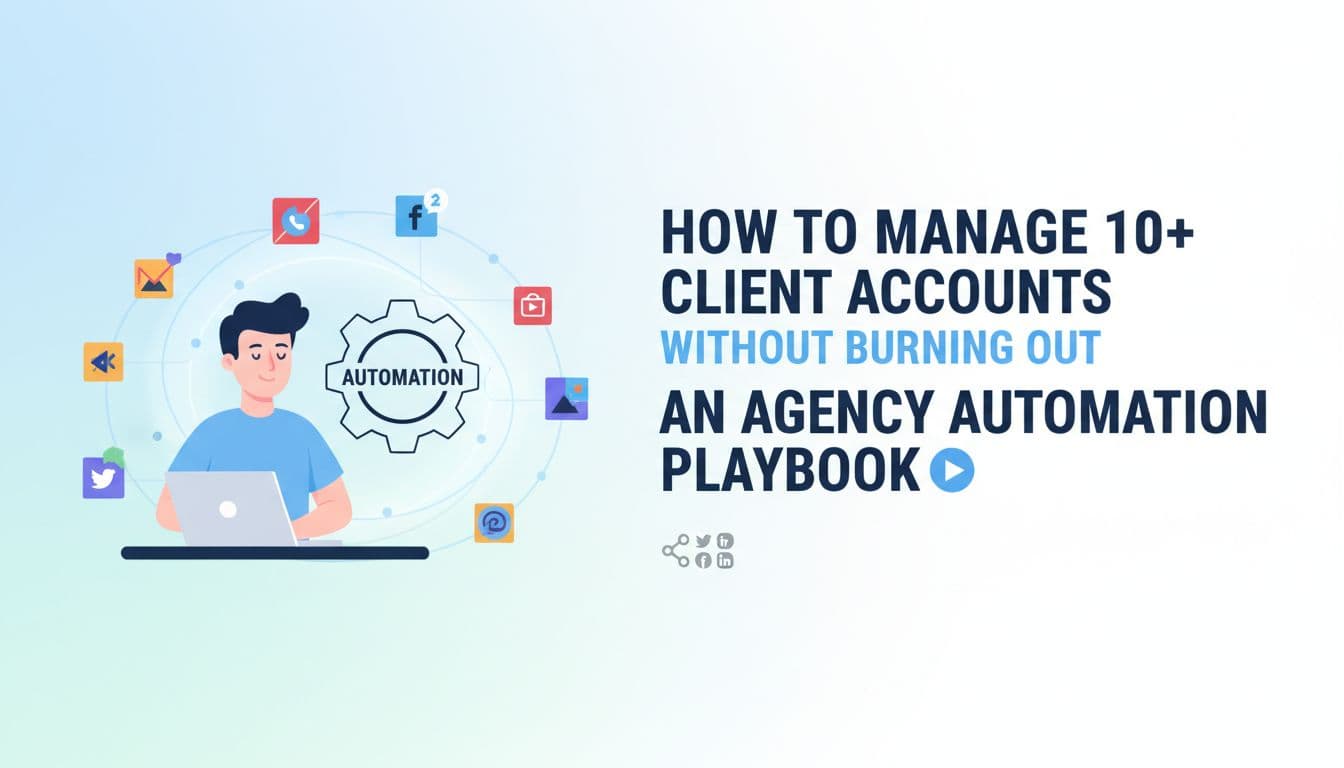
At some point between clients 5 and 7, most social media agency owners hit the same wall. The work is there. The revenue is there. But so is the exhaustion. You're spending Sunday nights reformatting content, Monday mornings chasing approvals, and Friday afternoons building reports you'll have to redo next month. You're not running an agency anymore. You're running a content assembly line, and you're the only worker on the floor.
The answer isn't to slow down growth or hire a full team you can't yet afford. It's to build a system that handles the mechanical work automatically so your brain stays free for the decisions that actually matter. This playbook walks through the five stages where agency time gets lost, and shows you what the automated version of each one looks like.
Why Agency Burnout Happens (And It's Not What You Think)
Most agency burnout comes from repetitive manual tasks like reformatting content for each platform, chasing client approvals over email, and rebuilding posts from scratch every week. Automation eliminates the grind, not the strategy.
Here's what that actually looks like in practice. You write a caption for a restaurant client. Then you reformat it for Instagram. Then shorten it for X. Then rewrite the hook for LinkedIn. Then you send a draft to the client over email, wait three days, get a vague "can we tweak the tone?" response, and start over. That's not strategy. That's data entry with a creative veneer.
The agencies that scale past 10 clients without falling apart aren't necessarily smarter or more talented. They've just stopped doing the same thing six times. They've built systems where the repetitive work happens automatically, and their attention stays on the decisions that actually move the needle for clients.
When you add up the time spent on reformatting, approval chasing, manual reporting, and rebuilding content templates every month, most agency owners lose 15 to 20 hours per week on work that could be automated. That's half a full-time employee. And it's the kind of work that drains you fastest because it's urgent, constant, and low-reward.
The fix isn't to hire faster. It's to stop doing the work that shouldn't require a human in the first place.
The Five Stages Where Time Gets Lost
Every agency workflow has five stages: onboarding a new client, creating content, getting it approved, scheduling it, and reporting on results. Most agencies have some automation in one or two of these stages, usually scheduling. But the time loss happens everywhere else.
A client onboarding that takes four hours could take 20 minutes with the right setup. An approval process that generates 30 emails could generate two. A reporting workflow that takes half a day could take 10 minutes. None of this requires cutting corners. It requires building the system once and letting it run.
The rest of this playbook goes stage by stage. For each one, you'll see what the manual version costs and what the automated version looks like in practice.
What Automation Actually Means for an Agency
Let's be clear about what automation does and doesn't do. It doesn't replace your judgment, your client relationships, or your creative instincts. Those are the things clients actually pay for. Automation handles the mechanical work: reformatting, reminding, routing, scheduling, and compiling. When you remove that mechanical layer, you get your brain back for the work that matters.
The agencies using tools like Aidelly aren't producing worse content because AI is involved. They're producing more consistent content because the brand voice, the templates, and the approval gates are built into the workflow. The human still makes the strategic calls. The system handles the execution.
Building a System That Scales: Onboarding, Creation, and Approvals
Stage 1: Client Onboarding That Takes Minutes, Not Hours
A structured onboarding system for each new client account, including stored brand voice guidelines, approved asset libraries, and platform-specific templates, cuts setup time per client from hours to minutes.
Think about what happens when you sign a new client today. You probably have a discovery call, take notes, maybe build a brand brief in a Google Doc. Then you manually set up their profiles in your scheduling tool, upload their logo and brand colors somewhere, write down their tone of voice in a note you'll forget to check, and start building content from scratch. By the time you've done all that for a new restaurant or e-commerce brand, you've spent three to five hours before a single post goes live.
The automated version looks different. You build a client profile once, inside your content platform, that stores the brand voice description, approved hashtags, preferred posting times, platform-specific guidelines, and a media library of approved photos and graphics. Every time you create content for that client, the system already knows their voice, their assets, and their rules.
In Aidelly, this lives inside the Brand Voice and Asset Management system. You set it up during onboarding, and every AI-generated draft for that client pulls from it automatically. A new team member can pick up a client account and produce on-brand content on day one because the brand rules are already baked in. That's not just faster. It's more consistent than relying on a human to remember a brand brief they read three weeks ago.
When onboarding takes 20 minutes instead of four hours, adding a new client stops feeling like a project and starts feeling like flipping a switch.
Stage 2: Content Creation at Scale Without Losing Brand Voice
AI-powered content generation that understands each client's brand voice means one content manager can handle 3 to 4 times more accounts without sacrificing quality or consistency.
This is the part most agencies get wrong when they first try AI content tools. They use a generic prompt, get generic output, and decide AI doesn't work for their clients. The problem isn't AI. The problem is that the AI didn't know anything about the client.
When brand voice guidelines are stored at the account level, every draft starts from the right place. A fitness coach client gets punchy, motivational copy. A B2B SaaS client gets precise, professional copy. A local bakery gets warm, conversational copy. The AI isn't guessing. It's working from the brief you built once during onboarding.
The math here is real. If one content manager can handle 5 accounts manually, the same person with AI-assisted drafting and stored brand profiles can handle 15 to 20 accounts without the quality dropping. You're not cutting the human out of the loop. You're cutting out the part where they stare at a blank screen for 45 minutes trying to write a caption for a client they've been managing for six months. The AI drafts, the human refines, and the output is faster and more consistent than the manual version.
Platform optimization matters here too. A caption that works on Instagram doesn't work on LinkedIn. An AI system that rewrites for each platform automatically saves another 30 to 60 minutes per client per week. Across 10 clients, that's a full workday every week handed back to you.
Stage 3: Killing the Approval Email Thread
Approval workflows are the single biggest time drain in agency operations. Moving from email threads to a structured review-and-approve system reduces back-and-forth by up to 80% and keeps content moving on schedule.
If you've managed more than three clients, you know the approval email thread. It starts with you sending a Google Doc or PDF. The client responds five days later with comments in the wrong version. Someone else on their team replies-all with contradictory feedback. You make changes, resend, and wait again. By the time the post is approved, the timing is off and you're scrambling to reschedule.
A structured approval workflow fixes this at the system level. Content goes into a review queue. The client gets a notification with a direct link to approve, request changes, or leave specific comments on specific posts. No email threads. No version confusion. No chasing.
The 80% reduction in back-and-forth isn't an exaggeration. When clients can see exactly what's going live, on what platform, on what date, and leave inline comments, the feedback gets sharper and the approval cycle gets shorter. Most clients approve content faster when the interface makes it easy, because they're not digging through attachments or trying to remember which draft is current.
For agencies, this also means content stays on schedule. When an approval is pending, the system knows. When it's approved, it moves to the publishing queue automatically. Nothing falls through the cracks because a client didn't respond to an email.
Scheduling, Reporting, and Running the Whole Operation
Stage 4: Scheduling That Runs Itself
Once content is approved, scheduling should be nearly invisible. Most agencies using basic tools like Buffer or Hootsuite are still manually selecting publish times, copying content across platforms, and rebuilding recurring posts every month. That's hours of work that adds zero strategic value.
A smarter scheduling system handles optimal timing automatically, based on when each client's audience is most active. It publishes across all platforms from one queue. It supports recurring templates so a "Monday motivation" post for a coaching client doesn't need to be rebuilt every week from scratch. You set the template once, and the system generates a fresh version on schedule.
The visual content calendar matters here too. When you're managing 10 clients, you need to see all of them at once. A good agency calendar shows every client's content pipeline in one view, so you can spot gaps, conflicts, or clients who are about to go dark before it becomes a problem. That kind of visibility is impossible when you're jumping between six different scheduling tools or managing everything in spreadsheets.
Stage 5: Reporting Without the Manual Grind
Cross-platform analytics consolidated into one dashboard lets account managers spot what is working across all clients in one sitting instead of logging into six platforms and building manual reports.
Monthly reporting is one of the most time-consuming tasks in any agency. You log into Instagram Insights, pull numbers, screenshot graphs, open a spreadsheet, do the same for Facebook, then LinkedIn, then TikTok. Then you build a slide deck or PDF that looks professional enough to send to the client. For one client, that's two to three hours. For 10 clients, that's a part-time job.
Consolidated analytics change the math entirely. When every platform's performance data lives in one dashboard, you can review all 10 clients in the time it used to take to review one. You see which content formats are performing, which platforms are growing, and which clients need a strategy conversation, all without opening a single native platform dashboard.
This also makes you a better strategist. When you can see patterns across clients quickly, you notice things. A reel format that's working for your restaurant client might work for your fitness client too. A posting time that's consistently underperforming for one client shows up clearly instead of getting buried in a manual report. The data is there. You just need a system that makes it readable without taking half your day.
For client-facing reporting, consolidated analytics also mean you can generate clean performance summaries faster. Clients get better reports. You spend less time building them. That's a win on both sides of the relationship.
Putting the Full System Together
The agencies that manage 15 or 20 clients without burning out aren't doing more work. They've built a system where each stage of the workflow feeds into the next. Onboarding loads the brand profile. The brand profile informs the AI drafts. The drafts go into an approval queue. Approved content moves to the schedule. The schedule publishes automatically. Analytics track the results. And the whole thing runs without anyone sending a single approval email or logging into a platform they don't need to touch.
This is what a modern social media agency actually looks like in 2026. Not more staff doing more manual work, but a tighter system where the repetitive work is handled and the humans focus on strategy, relationships, and growth.
The five stages aren't complicated. Onboarding, creation, approval, scheduling, reporting. You already do all five. The question is whether you're doing them manually or whether you've built the system that does them for you.
Managing 10 or more client accounts doesn't have to mean working 60-hour weeks. The agencies that scale without burning out have one thing in common: they stopped treating automation as a shortcut and started treating it as the operating system their business runs on. When your onboarding is systemized, your content drafts itself from stored brand guidelines, approvals move through a clean queue instead of an email chain, scheduling runs on autopilot, and reporting takes minutes instead of days, you get your capacity back without sacrificing quality for a single client.
The right tools make the difference between an agency that plateaus at 7 clients and one that comfortably manages 15. Every stage of your workflow can be tighter, faster, and less dependent on manual effort than it is today.
If you're ready to see what that system looks like in practice, Aidelly was built for exactly this.
Managing 10+ client accounts doesn't have to mean longer hours. Aidelly's automation workflows handle the repetitive work, from reformatting content across platforms to moving posts through approvals, so you can focus on the strategy that actually grows your clients' accounts. If you're ready to run a tighter agency without burning out your team, start at aidelly.ai.
Compare Social Scheduling Tools
Evaluating software for your content workflow? Use our buyer guides and comparisons to compare scheduling, approvals, analytics, and AI workflow fit.
Share this article
Related Articles
TikTok Scheduling for Small Businesses: How to Stay Consistent Without Being Glued to Your Phone
Most small business owners know they should post on TikTok more often. The problem is not motivation. It is that posting consistently while running a real business feels impossible when TikTok seems to demand you show up every single day, in real time, on demand. This article makes the case that consistency is not a willpower problem. It is an infrastructure problem. When you treat TikTok like a daily task you have to remember, you will always lose to the hundred other things competing for your attention. But when you build a system that handles creation, timing, and scheduling without you touching your phone every day, consistency becomes the default. Here is how small business owners in 2026 are using batch content creation, smart scheduling, and agentic AI workflows to stay active on TikTok without it eating their week.
May 20, 2026
Read more
How to Build an Agentic Social Media Workflow That Posts While You Sleep
Most social media tools promise automation but still leave you doing most of the work. You batch-write posts, pick times, upload images, and hit publish — just in a slightly more organized way. That is scheduling, not automation. A true agentic social media workflow is different. AI agents handle content ideation, copywriting, platform optimization, scheduling, and performance analysis without you approving each step. This article breaks down exactly what that looks like in practice: the four layers every agentic workflow needs, why brand voice is the piece most people get wrong, and how smart scheduling is not the same as picking a time slot on a calendar. If you are a solopreneur or running a lean team and social media feels like a part-time job you never signed up for, this is the architecture that changes that.
May 22, 2026
Read more
How Restaurants Can Schedule a Month of Social Content in Under Two Hours
Most restaurant owners spend 5 to 10 hours a month on social media and still post inconsistently. The problem is not effort. It is the lack of a repeatable system. This guide gives you a real, three-phase framework that takes under two hours once a month and keeps your restaurant visible all 30 days. You will learn how to batch your content, use agentic AI to handle the heavy lifting, and schedule everything across Instagram, Facebook, TikTok, and more without touching it again until next month. Whether you are running a busy dinner service solo or managing social for a handful of restaurant clients, this system works because it is built around how restaurants actually operate, not how marketing textbooks say they should.
May 21, 2026
Read moreReady to never miss a post again?
Tell Aidelly what to post. It drafts, schedules, and publishes across 9 platforms while you focus on your business.