LinkedIn Automation for Agencies: How to Scale Client Content Without Losing the Human Touch
If you manage LinkedIn content for more than five clients, you already know the problem. You are not short on scheduling tools. You are short on time to write 15 different posts that sound like 15 different people. And the moment one of them sounds like a template, you are one bad month away from a client asking why their LinkedIn is not growing.
This is the real challenge of LinkedIn automation for agencies in 2026. Speed is not the hard part anymore. Voice is. Consistency is. Building a system that can produce high-quality, on-brand LinkedIn content at scale without a team three times the size you have right now. That is what this article is actually about.
The Real Problem With LinkedIn Automation at Scale
Most agencies hit the same wall around client number eight or nine. The work does not get harder because there is more of it. It gets harder because every client has a different voice, a different audience, and a different reason someone should care about their LinkedIn presence. You cannot solve that with a faster scheduler.
Agencies managing 10 or more LinkedIn clients face a bottleneck that most automation tools completely ignore: writing platform-native content that actually sounds like each client wrote it. Not a template with the client's name dropped in. Not a reshuffled version of last week's post. Something that sounds like it came from a real person with a real point of view.
The fix is not just a scheduling tool. It is an AI system that stores and applies brand voice at the account level, so every post sounds like the client, not like the agency's default style. That means capturing tone, vocabulary, sentence structure, the topics they care about, and even the things they would never say. When that profile lives inside your workflow, the AI drafts from it every time. You stop rewriting from scratch and start editing toward something that already sounds right.
Think about what that saves. If you manage 15 clients and spend 45 minutes per client per week just trying to match their voice, that is 11 hours a week of work that should not exist. Brand voice storage at the account level turns that 45 minutes into a 10-minute review.
Platform-Native Content vs. Generic Posts
LinkedIn is not Instagram with a suit on. The content that performs well here is specific, opinionated, and written for professionals who are skimming a feed between meetings. Short paragraphs. A strong first line. A point that actually goes somewhere. Agencies that repurpose content from other platforms without adapting it for LinkedIn see the results in their analytics, and not in a good way.
Writing platform-native content means understanding what LinkedIn rewards. Personal stories tied to a business lesson. Takes on industry trends that are specific enough to spark a comment. Behind-the-scenes moments from a client's work that make their audience feel like insiders. Generic motivational posts and keyword-stuffed thought leadership do not land here anymore. The bar has gone up, and agencies that are still posting the same style of content they were in 2023 are watching reach quietly decline.
The Template Trap
Templates are not the enemy. Bad templates are. There is a difference between a structural framework, like always opening with a hook and closing with a question, and a fill-in-the-blank post that sounds the same whether it is coming from a fintech startup or a family-owned restaurant. Agencies that confuse the two end up with a feed full of posts that technically went out on time but did not actually do anything for the client's brand.
The goal is reusable structure with variable voice. Your process can be consistent. The output needs to sound like 15 different people. That distinction is what separates agencies that retain clients for three years from agencies that lose them after six months because the content never felt authentic.
Why Consistency Beats Volume Every Time on LinkedIn
LinkedIn's algorithm rewards consistency and engagement, not volume. That sentence is worth sitting with for a second because most agency automation conversations focus entirely on how many posts you can push out. The answer is not more posts. It is the right posts, showing up reliably, earning real reactions from real people.
When an account posts three times a week for eight weeks straight, LinkedIn starts to treat it as an active, credible presence. When that same account posts 15 times in two weeks and then goes quiet, the algorithm pulls back reach because the signal is inconsistent. Agencies that auto-post generic content to hit a volume target see declining reach over time. The posts go out but fewer people see them, and the ones who do are not engaging.
The winning approach pairs automated scheduling with human review gates. Nothing goes live without a quick approval check. That single step is what keeps the content feeling intentional instead of robotic. Automated scheduling handles the timing and the cadence. The human review handles the quality. You get the efficiency of automation without the risk of a post going out that the client would never have approved.
Engagement Is a Signal, Not a Vanity Metric
When someone comments on a LinkedIn post, the algorithm shows it to more people. When nobody engages, reach drops. This means every post that goes out without earning a reaction is working against the account's future visibility. Agencies that treat LinkedIn as a broadcast channel instead of a conversation platform are fighting the algorithm every single week.
Good engagement starts with good content. But it also depends on posting at the right time, responding to comments quickly, and building the kind of presence that makes people want to interact. Automation handles the first part. The agency and the client handle the rest. The split of responsibilities matters here. Automate production. Keep humans in charge of relationships.
Approval Workflows as a Quality Gate
Approval workflows are the missing piece most agency automation setups skip entirely. When a client can review and approve a post before it publishes, two things happen. Trust goes up because the client feels like a partner in the process instead of someone things are being done to. And revision requests go down because problems get caught before they become published mistakes.
That single workflow change saves agencies hours per week per client. Think about the back-and-forth that happens when a post goes live and the client does not like it. You pull it down, rewrite it, get feedback, rewrite again. That whole loop disappears when there is a proper approval step built into the process. The client sees it, approves it or flags it, and it either publishes or goes back for a quick edit. Clean, fast, and nobody is sending panicked messages at 9am because something went out wrong.
Aidelly's approval workflow is built directly into the content pipeline. Clients get a review link before anything publishes. Account managers get notified when something is approved or flagged. The whole process lives in one place instead of scattered across email threads and shared docs.
Using Data to Post at the Right Time for Each Client
The best time to post on LinkedIn is not Tuesday at 10am. That is a generalization based on averages across millions of accounts, and averages are useless when you are managing a portfolio of clients with completely different audiences. A B2B software company targeting enterprise CTOs has a different optimal posting window than a career coach whose audience is mid-level managers looking for their next move.
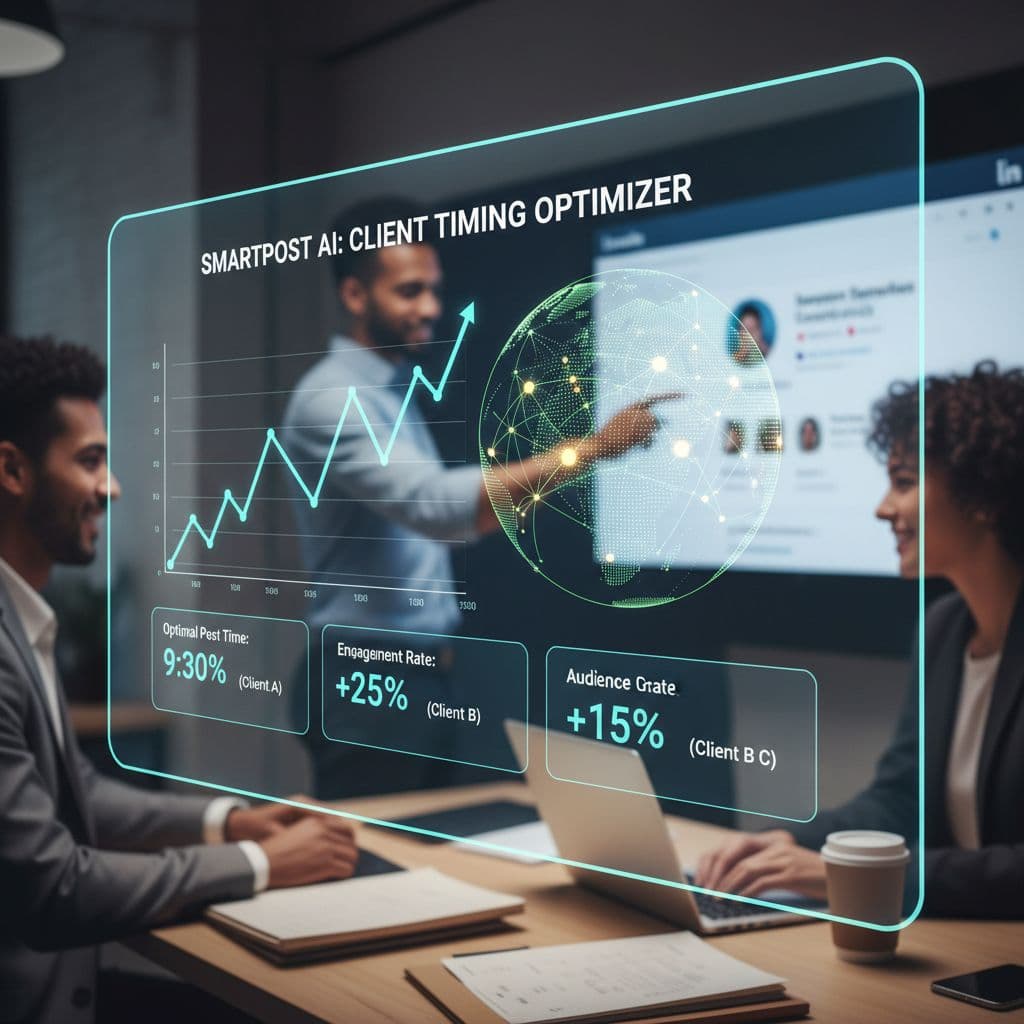
Agencies that rely on platform defaults or generic best-practices articles are leaving performance on the table. The data to figure out the right window for each client exists. It lives in the analytics. But pulling it manually for 15 accounts every month is not realistic. AI-powered analytics that track per-client optimal posting windows give agencies a data edge their clients can see in the numbers.
When you can show a client that their posts published between 7:30am and 8:15am on weekdays consistently outperform posts published at noon by 40%, that is a conversation that builds trust. It is also a conversation that justifies your retainer. You are not just posting content. You are using data to make every post work harder.
Building Per-Client Performance Baselines
Every client starts without data. The first 60 to 90 days of a LinkedIn engagement are partly about building a baseline. What times get the most impressions? What content formats get the most comments? What topics drive profile visits? Once you have that data, you can stop guessing and start optimizing.
The agencies that do this well treat LinkedIn analytics as an ongoing input to their content strategy, not just a monthly report they send to the client. They look at what worked last month and use it to inform what gets written this month. That feedback loop is what separates agencies that grow client accounts from agencies that just maintain them. Maintenance is a commodity. Growth is a retainer worth keeping.
Cross-Platform Timing Considerations
For agencies managing clients across multiple platforms, timing gets more complex fast. A post that performs well on LinkedIn at 8am might need to go out at 6pm on Instagram to hit the same audience. Managing those windows manually across six platforms and 15 clients is a full-time job on its own.
Cross-platform analytics that surface per-channel, per-client timing data in one dashboard make that manageable. You see everything in one place and schedule accordingly instead of toggling between five different native analytics tools and trying to hold the numbers in your head. The time you save on that alone is meaningful, but the bigger win is that you make better decisions because the data is actually in front of you when you need it.
How Agentic AI Workflows Let You Scale Without Hiring
Scaling LinkedIn content across clients does not require more headcount. That sounds like a bold claim until you break down where agency time goes. Writing first drafts. Reformatting content for different platforms. Chasing client approvals. Pulling performance data. Scheduling posts. Responding to last-minute changes. Most of that work is repeatable and process-driven, which means it is exactly the kind of work AI handles well.
Agencies that use agentic AI workflows to draft, schedule, and optimize posts can manage three times the client load without adding staff, as long as the system keeps brand voice and approval steps intact. That last part is the catch. Automation without brand voice guardrails produces generic content. Automation without approval gates produces trust problems. But when both are built into the system, you get the throughput of a larger team with the quality control of a smaller one.
Here is what that looks like in practice. An account manager sets up a brand voice profile for a new client, uploads their guidelines, past posts, and any reference content that captures how they sound. The AI drafts a week's worth of LinkedIn posts from that profile. The account manager does a quick review, makes small edits, and queues the posts for client approval. The client approves in 10 minutes. Everything schedules automatically. That whole process might take 90 minutes for a client that used to take four hours.
Agentic Workflows vs. Basic Scheduling
There is a real difference between a scheduling tool and an agentic workflow. A scheduler takes content you have already created and publishes it at a time you specify. An agentic workflow creates the content, applies the brand voice, picks the optimal time, routes it for approval, and publishes it. The human stays in the loop for review and judgment. The AI handles the production work.
Aidelly is built around agentic workflows specifically because agencies need more than a calendar. They need a system that holds the whole operation together from first draft to published post to performance report. The AI Chat Workspace lets account managers create, refine, and schedule posts through one guided workflow instead of jumping between a writing tool, a scheduler, and an analytics dashboard. That consolidation alone cuts context-switching, which is one of the quietest time thieves in any agency.
Keeping Quality High at Scale
The risk with any automation system is that quality drifts as volume increases. The way to prevent that is to build quality checks into the process itself rather than relying on people to catch problems after the fact. Brand voice profiles catch tone drift. Approval workflows catch factual errors and off-brand moments. Analytics catch performance drops before they become patterns.
When those three systems work together, quality does not degrade at scale. It gets more consistent. Because the AI is always drafting from the same voice profile, every post goes through the same review gate, and the data is always feeding back into the strategy. That consistency is what clients pay retainers for. They want their LinkedIn presence to feel like a coherent, ongoing conversation with their audience, not a random collection of posts that went out on schedule and did nothing.
The agencies winning on LinkedIn in 2026 are not the ones posting the most. They are the ones posting consistently, on-brand, at the right time, with a client approval process that builds trust instead of friction. That combination, brand voice at the account level, smart scheduling, approval gates, and analytics that actually inform strategy, is what turns LinkedIn from a time sink into a real growth channel for clients.
Getting there requires the right system underneath it all. Not five tools duct-taped together, but one platform that holds the whole workflow from draft to publish to report. When that system is in place, the question stops being how do we keep up and starts being how many more clients can we take on.
If you are ready to see what that looks like for your agency, Aidelly is worth a closer look.
Scaling LinkedIn content across 10, 20, or 30 clients does not require more people. It requires a system that holds the voice, the schedule, and the approval process together without you babysitting every step. Aidelly's agentic workflows handle the full loop, from drafting posts in each client's voice to scheduling at the right time to tracking what actually performs. If you want to see what that looks like for your agency, start at aidelly.ai.
Compare Social Scheduling Tools
Evaluating software for your content workflow? Use our buyer guides and comparisons to compare scheduling, approvals, analytics, and AI workflow fit.
Share this article
Related Articles
AI Content Approval Workflows: How Agencies Cut Review Time in Half
If you run a social media agency, you know the approval process can kill momentum faster than anything else. A post gets drafted, sent to the client, and then it sits. Days pass. You follow up. They request changes. You revise. They forward it to someone else. By the time it gets approved, the moment has passed. In 2026, agencies that are still running manual approval chains are leaving time and money on the table. AI content approval workflows change how the whole process works — not by replacing human judgment, but by handling the slow, repetitive parts automatically. This guide breaks down exactly how these workflows operate, where they save the most time, and what agencies need to put one in place today.
May 24, 2026
Read more
Multi-Client Social Media Reporting: How Agencies Automate Analytics Delivery
If you manage more than five client accounts, you already know the reporting grind. Every month, you pull numbers from Instagram, TikTok, LinkedIn, Facebook, X, and YouTube, drop them into a spreadsheet or a deck, write a summary, and send it off. Then you do it again for the next client. And the next. For a mid-size agency, that process can eat 40 or 50 hours a month before you've done any actual strategy work. But the real problem isn't the time. It's what manual reporting signals to your clients. When you're buried in data entry, you're not thinking about what's next for their brand. You're just catching up. This article is about a different model: one where AI agents handle the data collection, the formatting, and the delivery, so your team shows up to client calls with insights instead of spreadsheets. That shift changes how clients see you.
May 31, 2026
Read more
White-Label Social Media Automation: How Agencies Use Agentic AI to Sell a Content Pipeline, Not Hours
Most agencies still bill for social media by the hour. One person handles content for five clients. Another handles ten. Eventually you hit a ceiling — more clients means more hires, and margins shrink. But a different model is taking hold in 2026. Agencies are packaging AI-powered social media automation as a productized service, delivering consistent branded content for dozens of clients without growing headcount. The shift isn't just about scheduling tools. It's about agentic AI workflows that handle ideation, drafting, scheduling, and reporting end-to-end. This article walks through what that model looks like operationally: how to pick the right platform, how to protect client brand voice at scale, how to structure your service tiers, and how REST APIs and MCP server connections let you build a custom client experience on top of existing infrastructure. If you run an agency and you're still selling hours, this is worth reading.
Jun 9, 2026
Read moreReady to never miss a post again?
Tell Aidelly what to post. It drafts, schedules, and publishes across 9 platforms while you focus on your business.