Seasonal Campaign Scheduling: How Ecommerce Brands Plan 12 Months of Social Content
Every November, the same thing happens at ecommerce brands everywhere. Someone realizes Black Friday is three weeks away. The team scrambles. Captions get written in a rush. Product images get pulled from last year's campaign. Posts go out with typos, wrong prices, or on the wrong platform entirely. The sale still happens, but the content that was supposed to drive it was an afterthought.
It doesn't have to work that way. Brands that build a real 12-month social media calendar before January 1 stop scrambling and start executing. They know what's going live in October before they've finished their summer sale. They have Q4 content drafted in September. They post consistently in the slow months that most brands ignore, so when peak season hits, they have a warm audience ready to buy.
This article is about how to build that system. Not just what to post, but how to plan, platform-match, schedule, and approve content across a full year without the whole thing collapsing under deadline pressure. And how agentic AI makes it possible for a small team to run a content operation that used to require a full department.
Start With the Retail Calendar, Not a Blank Page
Ecommerce brands that plan content 12 months out spend less time reacting and more time executing. The key is mapping your content calendar to the retail calendar first, then layering in brand moments, product launches, and evergreen content around it. Q4 alone — October through December — accounts for over 30% of annual ecommerce revenue, so that window needs its own dedicated planning phase, not a last-minute scramble.
But here's the thing: most brands start planning Q4 in October. By then, you're already behind. Your competitors who started in August have content queued, ads approved, and email sequences ready. You're still writing product descriptions at 11 PM the week before Black Friday.
Map the Retail Calendar First
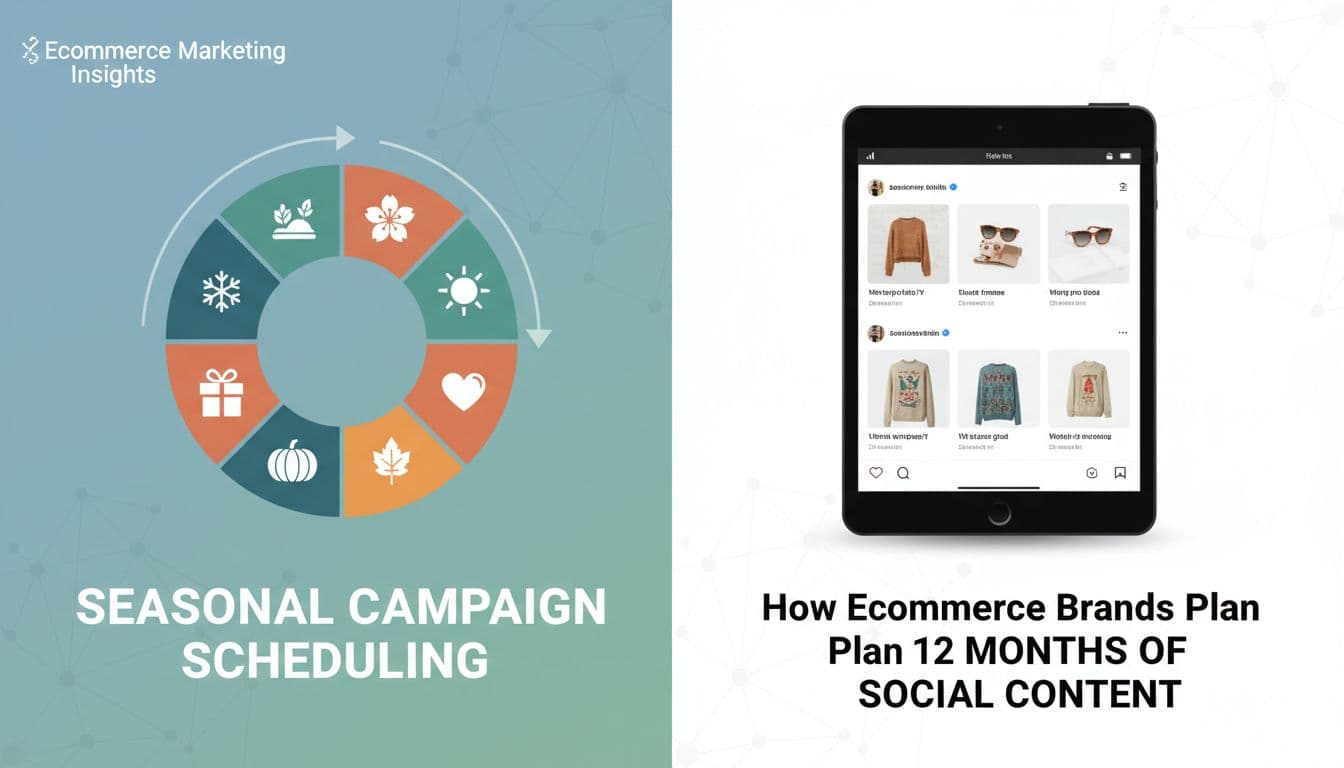
Pull up a blank calendar for the full year. Before you write a single post, mark every retail moment that matters to your category. For most ecommerce brands, that list includes New Year clearance in January, Valentine's Day in February, spring launches in March, Mother's Day in May, summer sales in June and July, back-to-school in August, Halloween in October, and then the Q4 gauntlet of BFCM, holiday gifting, and year-end sales from November through December.
Once those anchors are in, you can see the shape of your year. You'll notice something immediately: there are long stretches between the big moments. That's not dead space. That's where consistent brands pull ahead. More on that later. The point right now is that you can't build a content plan until you know what you're planning around. Start with the retail anchors. Everything else layers in after.
Layer In Your Brand Moments
After the retail anchors, add your own brand calendar. Product launches, anniversary sales, founder stories, behind-the-scenes content, user-generated campaigns. These are the posts that make your brand feel like a brand and not just a store running promotions. A candle company might plan a 'how we source our wax' series for February. A skincare brand might build a 30-day skin challenge for March. These aren't tied to retail holidays, but they keep your audience engaged and give your content calendar texture.
The goal is a calendar where every week has a purpose. Some weeks are promotional. Some are educational. Some are pure community-building. When you plan all three types across 52 weeks, you stop treating social media like a megaphone and start treating it like a relationship. That shift alone changes how your audience responds to you when you do ask them to buy something.
Build Q4 as Its Own Project
Q4 deserves a separate planning session. The revenue stakes are too high to fold it into your regular monthly planning. Start your Q4 planning in July. Map every promotional moment from October 1 through December 31. Assign content types to each moment. Decide which platforms get what. Set internal deadlines for creative, copy, and approvals that work backward from your go-live dates.
If your Black Friday sale goes live November 28, your content needs to be approved by November 14, drafted by November 7, and briefed by October 28. Build the timeline before you build the content. When you have those backward-mapped deadlines on your calendar, Q4 stops feeling like a crisis and starts feeling like a project with a plan. That mental shift alone reduces the scramble more than any tool can.
Platform-Specific Content Is Not Optional
Seasonal campaigns fail when teams treat each platform the same. Instagram rewards visual storytelling and Reels for holiday gift guides. TikTok rewards trend-reactive short video. LinkedIn rewards B2B angle content like 'how we prep our store for BFCM.' Facebook rewards event-based posts and paid amplification. A 12-month calendar needs platform-specific content types mapped to each season, not one post copied across all channels.
Copy-pasting the same caption to Instagram, TikTok, LinkedIn, and Facebook is one of the most common mistakes small ecommerce teams make. It feels efficient. It's not. Each platform has its own algorithm, its own audience behavior, and its own content format that performs. When you ignore those differences, you get mediocre results everywhere instead of strong results somewhere.
Instagram and TikTok: Visual-First, Format-Specific
On Instagram, holiday content that performs tends to be polished and aspirational. Gift guides as Reels. Flat lays of product bundles. Behind-the-scenes packing videos. Stories with countdown stickers for flash sales. The format matters as much as the message. A gift guide that works as a static carousel in October might need to be reformatted as a Reel in November when Reels are getting more reach.
TikTok is different. The content that wins there is reactive, native, and often a little raw. For ecommerce brands, that might mean a 'packing your Black Friday orders at 2 AM' video, a trending audio layered over a product reveal, or a founder talking directly to camera about why they started the brand. TikTok audiences can smell a repurposed Instagram post immediately. Plan TikTok content separately, and give it room to feel spontaneous even within a planned framework. That balance is hard but worth it.
LinkedIn and Facebook: Different Jobs, Different Content
LinkedIn is underused by ecommerce brands, but it's a real channel for B2B-adjacent content. If you sell wholesale, run a subscription box, or have a brand story worth telling, LinkedIn is where you share the operational side of your business. 'How we're prepping our warehouse for BFCM' or 'what we learned from our worst Q4' are posts that perform well there and build brand credibility with a different audience than your buyers.
Facebook still drives significant traffic for ecommerce brands, especially through paid amplification and event-based posts. A Facebook event for your holiday sale, boosted to a warm audience, can outperform organic Instagram content during peak season. Plan Facebook content with promotion in mind. It's less about organic reach and more about using the platform's tools to extend the reach of your best seasonal content to the people most likely to buy.
Build a Platform Matrix Into Your Calendar
For each major campaign on your calendar, build a simple matrix: what format goes on which platform, and what's the unique angle for each. A holiday gift guide campaign might be a Reel series on Instagram, a trending audio video on TikTok, a 'gift guide for the person who has everything' post shared on Facebook, and a LinkedIn post about how you curated the selection. Same campaign, four different executions.
That's how you get full-funnel coverage without creating four times the work. You're not starting from scratch for each platform. You're taking one campaign idea and translating it into the format and angle that fits each channel. Once you build this habit into your planning process, it becomes fast. And tools like Aidelly's AI-powered content drafting can generate platform-specific versions of a single campaign brief automatically, so your team isn't rewriting the same message four times by hand.
The Shoulder Seasons Are Where You Win or Lose Reach
The biggest gap in most ecommerce content calendars is the dead zones between peak seasons. February, late March, June, and September are low-competition windows where brands that post consistently outperform brands that go quiet. Planning content for these shoulder periods, like back-to-school prep content in July or post-holiday clearance content in January, keeps audiences warm and improves algorithmic reach when peak season hits.
Here's what actually happens when you go quiet in the off-months: the algorithm forgets you. Your engagement rate drops. Your follower growth stalls. And when you come back loud in October with your holiday campaign, you're starting from a smaller, colder audience than you would have had if you'd kept posting in August and September. The shoulder seasons aren't slow periods. They're the periods that determine how well your peak season performs.

January and February: The Overlooked Window
January is one of the lowest-competition months in ecommerce social media. Most brands go quiet after the holiday push. That's your opening. Post-holiday clearance content, new year product resets, 'what's coming in 2026' teasers, and customer story content all perform well in January because there's less noise to cut through.
February is Valentine's Day territory, but it's also a great month for educational content, loyalty campaigns, and building the audience you'll need for your spring launch. A home goods brand that posts consistently in January and February, mixing clearance promotions with 'refresh your space' content, will have a warmer, larger audience when their spring collection drops in March. The work you do in the shoulder season pays off in the peak season. That's not a theory. It's how algorithms reward consistent posting behavior over time, and it's why the brands that show up in February are the ones that clean up in April.
June and September: Pre-Season Priming
June sits between Mother's Day and back-to-school, and most brands treat it like a gap. It's not. It's a chance to build anticipation for your summer sale, introduce new products, and run community-building content that doesn't have a promotional agenda. Audiences that feel connected to your brand in June are more likely to buy from you in July when the sale actually runs.
September is the most underrated month in the ecommerce calendar. It's the last quiet month before Q4. Brands that use September to prime their audience, tease upcoming holiday products, and build their email and social following will have a bigger, more engaged audience when BFCM hits. Run a 'what's coming this holiday season' campaign in September. Let your audience feel like insiders. Give them early access previews, sneak peeks of new products, or a waitlist for your holiday drop. It builds the kind of loyalty that converts in November when every other brand is also running a sale.
Evergreen Content as the Glue
Shoulder seasons are also the right time to publish evergreen content that supports your brand presence year-round. How-to posts, product education videos, customer testimonials, and behind-the-scenes content don't expire. They keep working after you post them. A video explaining how to style your product, posted in March, can drive saves and shares through August.
Mixing evergreen content into your shoulder season calendar means you're building long-term brand equity while keeping your posting cadence consistent. It's the lowest-effort, highest-return content type most ecommerce brands underuse. And when you plan it in advance and drop it into the gaps between campaigns, your calendar stops having dead zones. Every week has something going out. Every week, your audience hears from you. That consistency is what keeps your reach healthy when peak season arrives and you need it most.
The Workflow Behind the Calendar Is What Actually Matters
A beautiful 12-month calendar is useless if your team can't execute it. And for most small ecommerce teams, execution breaks down in two places: approval bottlenecks and bad timing. Both are solvable with the right workflow. The brands that publish consistently, on time, and on-brand across six platforms aren't necessarily bigger or better-resourced than yours. They just have a system that doesn't depend on everyone remembering to do the right thing at the right moment.
Approval Workflows That Don't Break Under Pressure
Approval bottlenecks kill seasonal campaigns. When a team of three has to manually review, revise, and approve 30 posts before Black Friday, something always slips. A caption goes out with the wrong discount code. A product image shows last year's packaging. A post goes live on the wrong day. Brands that build approval workflows into their scheduling process, with clear review gates and automated handoffs, publish faster and with fewer errors. Agentic workflows that auto-draft and queue posts for approval cut the manual back-and-forth that wastes the most time.
The fix isn't hiring more people. It's building a process where drafts move through review automatically, comments are tracked in one place, and nothing gets published without a sign-off. Aidelly's approval workflow does exactly that. AI agents draft the content, queue it for review, and the team approves or edits before anything goes live. The back-and-forth that used to eat three days before a campaign launch gets compressed into a few hours. Build your approval timeline backward from every go-live date on your calendar. If a post goes live November 28, the final approval deadline is November 25, the first draft is due November 20, and the brief is written November 15. Put those internal deadlines on the calendar alongside the public-facing content dates. When everyone can see the full timeline, nothing sneaks up on the team.
Auto-Scheduling and Optimal Post Timing
Post timing matters more during peak seasons because everyone is competing for the same eyeballs. Data consistently shows that ecommerce posts during BFCM and holiday weeks get higher engagement between 7 and 9 AM and 7 and 9 PM in the audience's local time. Auto-scheduling tools that analyze past performance and pick optimal send times give brands a measurable edge over teams scheduling manually by guessing.
During BFCM week, your audience is checking their phones before work and after dinner. They're in buying mode. A post that goes live at 6:47 AM because someone hit publish early misses the 7 AM window when engagement spikes. A post that goes live at 7:02 AM because your auto-scheduler analyzed your last 90 days of performance data and picked that slot hits the window every time. That's not a small difference. During peak season, when you're competing with every other brand your customer follows, timing is a real advantage. Over a full year, hundreds of posts going out at the right time instead of whenever someone remembered to hit publish adds up to a meaningful lift in reach and revenue.
Agentic AI as the Engine Behind the System
The reason most 12-month content plans fail isn't bad strategy. It's the gap between planning and doing. Someone builds a solid calendar in a spreadsheet in January, and by March the team is behind, the calendar is stale, and everyone's back to reacting. Agentic AI closes that gap by handling the execution layer autonomously.
With agentic social media workflows, AI agents can draft platform-specific content based on your stored brand voice guidelines, queue it for approval, schedule it at optimal times, and analyze performance after it goes live. All without someone manually driving each step. For a two-person ecommerce team managing six channels, that's the difference between a content calendar that runs all year and one that gets abandoned by Q2. The plan stays alive because the system keeps executing it, not because someone found extra hours in their week. That's the real value of agentic AI in social media management: it doesn't just help you plan better, it helps you actually follow through.
A 12-month ecommerce social media calendar only works if the workflow behind it holds up under pressure. That means mapping your content to the retail calendar before January, building platform-specific content for each season, staying active in the shoulder months most brands skip, locking in approval workflows before Q4 hits, and letting auto-scheduling handle the timing decisions your team shouldn't be guessing at. That's a lot to manage manually. The brands that execute it consistently aren't doing more work. They're using better systems. If you're ready to stop scrambling before every holiday and start running a content operation that actually holds up all year, the right infrastructure makes that possible.
If you want a low-lift way to apply these ideas, Aidelly helps you keep your social content consistent without extra busywork.A 12-month content calendar is only useful if your team can actually execute it without burning out every time a peak season hits. Aidelly's agentic workflows handle content creation, scheduling, and performance analysis so you're not manually pushing posts at 11 PM before Black Friday. Build the plan once and let the system run it. Start at aidelly.ai.
Compare Social Scheduling Tools
Evaluating software for your content workflow? Use our buyer guides and comparisons to compare scheduling, approvals, analytics, and AI workflow fit.
Share this article
Related Articles
Brand Voice on Social Media: How to Stay Consistent Across Every Platform and Post
Most brands treat brand voice consistency as a writing problem. Write a good style guide, share it with the team, and done. But that is not how it works in practice. The real problem is operational. Every platform you add, every post you publish, and every person who touches your content creates another chance for your voice to drift. A word here, a tone shift there. Over weeks, your brand starts to sound like three different people. This article breaks down what brand voice actually includes, why volume is the biggest threat to consistency, how to make your voice flex across platforms without losing its core, and why agentic AI workflows are the only way to hold your brand voice at scale. If you are about to hand off social content to a team or an AI tool, this is the article to read first.
May 5, 2026
Read more
How to Integrate AI Agents Into Your Social Media Stack Using MCP Servers
Most AI tools help you write social media posts. This article is about making AI actually post them. MCP (Model Context Protocol) is the open standard that turns a chatbot into an autonomous social media agent. It lets AI assistants like Claude and ChatGPT connect directly to platforms like Aidelly and take real actions: drafting content, scheduling posts, routing approvals, and pulling analytics. No copy-pasting. No tab-switching. No manual handoff. Only about 7 platforms in the world currently support MCP for social media, which means the marketers and developers who set this up now are running a workflow most of their competitors have never heard of. This guide breaks down what MCP is, why it matters specifically for social media, and how to connect your AI assistant to an agentic social media stack that runs end-to-end without you babysitting every step.
May 30, 2026
Read more
Multi-Client Social Media Reporting: How Agencies Automate Analytics Delivery
If you manage more than five client accounts, you already know the reporting grind. Every month, you pull numbers from Instagram, TikTok, LinkedIn, Facebook, X, and YouTube, drop them into a spreadsheet or a deck, write a summary, and send it off. Then you do it again for the next client. And the next. For a mid-size agency, that process can eat 40 or 50 hours a month before you've done any actual strategy work. But the real problem isn't the time. It's what manual reporting signals to your clients. When you're buried in data entry, you're not thinking about what's next for their brand. You're just catching up. This article is about a different model: one where AI agents handle the data collection, the formatting, and the delivery, so your team shows up to client calls with insights instead of spreadsheets. That shift changes how clients see you.
May 31, 2026
Read moreReady to never miss a post again?
Tell Aidelly what to post. It drafts, schedules, and publishes across 9 platforms while you focus on your business.