Agentic AI vs. Copilot AI: Which Social Media Automation Model Is Right for Your Team
You've probably already tried an AI writing tool. You typed a prompt, got a draft, fixed it up, and then went back to manually scheduling it, checking the analytics, and figuring out what to write next week. The AI helped, but you were still doing most of the work. That's not a flaw in how you're using the tool. It's a flaw in the model itself.
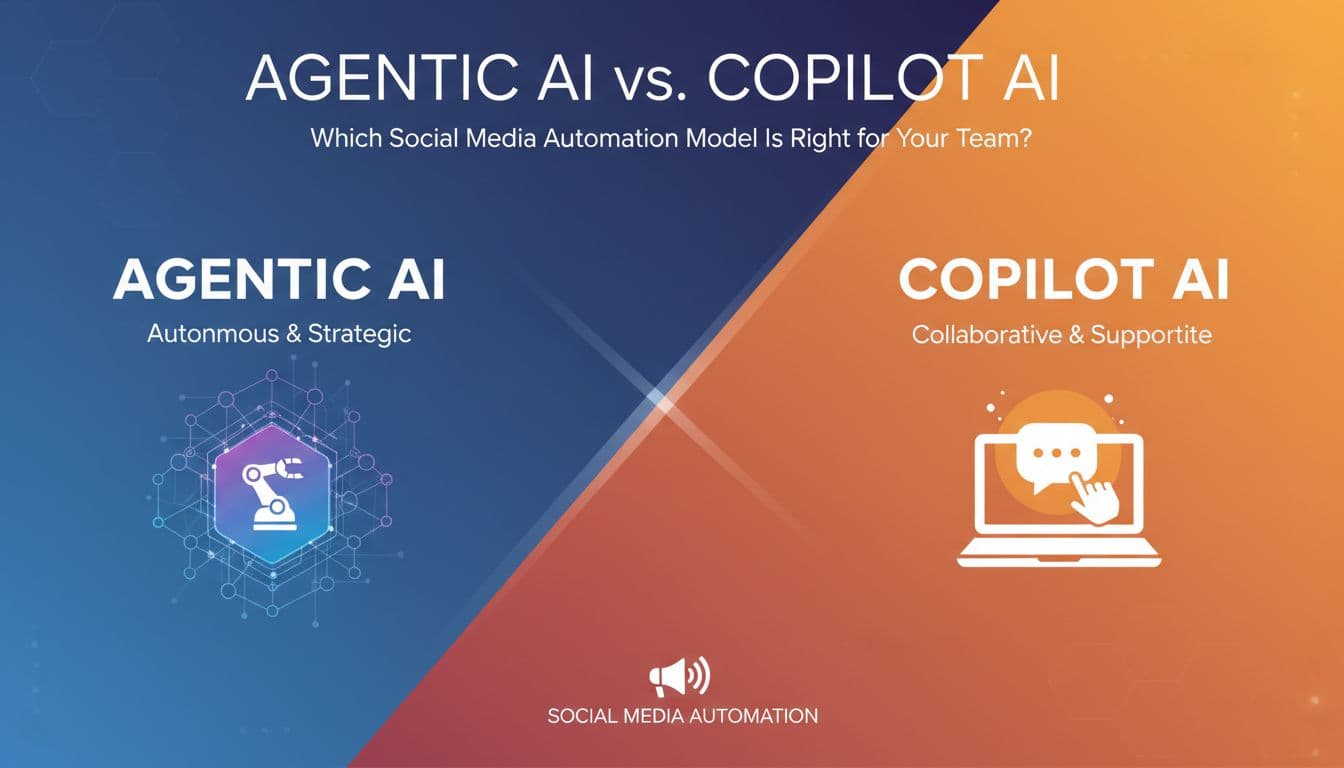
Copilot AI and agentic AI are not just different levels of the same thing. They represent two fundamentally different answers to the question of where your team's attention should live. One makes you faster at doing tasks. The other removes tasks from your plate entirely. For social media managers, solopreneurs, and agency owners who are tired of how much manual effort still survives even after adopting AI tools, understanding this distinction is the most practical thing you can do in 2026.
The Real Difference Between Copilot AI and Agentic AI
You've probably used a copilot-style AI tool. You open a chat window, describe what you need, read the output, tweak it, copy it somewhere else, and then go schedule it manually. The AI helped. But you still did most of the work.
That's not a criticism of those tools. Copilot AI is useful. It makes you faster at writing, faster at brainstorming, faster at editing. But faster is not the same as free.
What Copilot AI Actually Does
A copilot AI assists you at each step of a task. It waits for your input before it acts. You ask it to write a LinkedIn post, it writes one, and then it stops. You ask it to suggest a posting time, it suggests one, and then it stops again. Every decision still runs through you. The AI is a capable assistant, but you're still holding the wheel at every turn.
For a lot of tasks, that's exactly what you want. Writing a sensitive client announcement, responding to a PR situation, crafting a campaign launch message — those deserve a human in the loop. The copilot model fits those moments well. But most social media content isn't that sensitive. A Tuesday morning post about your product's newest feature, a Friday recap for your Instagram audience, a LinkedIn summary that mirrors your best-performing content from last month — these decisions don't need you. They need context and consistency.
What Agentic AI Actually Does
Copilot AI assists humans at each step, waiting for input before acting, while agentic AI runs full workflows end-to-end without needing a human to approve every move. That distinction matters a lot more than it sounds, because it changes how much time your team actually saves.
With a copilot tool, you save maybe 20 minutes writing a post. With an agentic system, you save the entire task. The agent drafts the content, checks it against your brand voice guidelines, picks the best time to post based on historical performance data, schedules it across platforms, and flags you only if something falls outside the rules you've set. You didn't just work faster. You didn't work on that task at all.
This is the core shift. Copilot AI compresses the time you spend on tasks. Agentic AI removes tasks from your plate entirely. For teams where attention is the real constraint — not skill or speed — that's a fundamentally different kind of value. Think about what your week looks like if you run social for a mid-size brand. You're not slow at writing captions. You're buried under the volume of decisions: what to post, when to post it, which platform gets which version, whether this draft matches the brand voice, who needs to approve it before it goes live. A copilot speeds up the writing part. An agentic workflow handles the whole chain.
Why the Distinction Changes Your Hiring Math
Here's a practical way to think about it. If you're using copilot AI, you still need someone to manage the tool. Every post still requires a human to initiate, review, and publish. That person's time is your real cost. Agentic AI changes the ratio. One person can oversee a content pipeline that would have previously required two or three people to maintain, because the agent handles execution and that person handles strategy and exceptions.
That doesn't mean agentic AI is always the right choice. It means the choice has real consequences for how you staff, how you structure your week, and how much content you can realistically produce. The teams that understand this early are the ones that stop asking 'how do we write faster' and start asking 'what decisions can we stop making ourselves.'
What Each Model Looks Like for Three Real Team Types
The best way to understand the copilot-versus-agentic question is to stop thinking about it abstractly and look at what each model actually produces day-to-day for different kinds of teams.
The Solopreneur Running Six Platforms
For solo operators and small teams, agentic AI handles the entire content pipeline, from ideation to scheduling to performance review, so one person can maintain a consistent presence across six platforms without hiring help.
Picture someone running a personal brand as a fitness coach. She has an Instagram audience, a TikTok following, a LinkedIn presence for B2B partnerships, a YouTube channel, a Facebook community, and an X account she uses for industry commentary. Keeping all six active with original, platform-appropriate content is a full-time job. She doesn't have a full-time job to give it.
With a copilot tool, she speeds up the writing but still touches every post. She still decides what to write about each week, still formats it for each platform, still schedules everything manually. She saves maybe five hours a week but still spends fifteen on content alone.
With an agentic workflow, the system pulls from her content pillars, checks what performed well last week, generates platform-specific drafts, and schedules them at optimal times. She reviews a weekly summary and approves or adjusts anything that feels off. Her active involvement drops from fifteen hours to maybe three. That's not an efficiency gain. That's a different life. Aidelly's agentic workflows are built for exactly this scenario — agents handle ideation, drafting, scheduling, and performance review end-to-end, so a single operator can stay consistently present across every platform without burning out.
The Small In-House Team Trying to Scale
A small marketing team at a SaaS company — say three people covering content, paid, and email — faces a different problem. They have enough hands to produce content, but not enough to produce it at the volume and consistency that social media actually rewards.
For this team, the copilot model works fine for high-stakes content: product launches, thought leadership pieces, anything that needs a careful eye. But for the steady drumbeat of weekly posts, platform updates, and repurposed content, the copilot model creates a bottleneck. Someone has to initiate every piece. Someone has to schedule it. Someone has to check the analytics and decide what to do differently next week.
Agentic AI shifts that calculus. The team sets the strategy, defines the brand voice, and approves the content pillars. Then the agents execute. The team's attention moves from production to strategy, which is where it should have been all along. They produce more content, with better consistency, without adding a headcount. That's the outcome a three-person team actually needs.
The Agency Managing a Dozen Client Accounts
Agencies have a different problem entirely. They need automation, but they can't afford to lose control. Posting the wrong content to the wrong client's account, or publishing something that hasn't been approved, is a relationship-ending mistake.
The right model here depends on your team's risk tolerance and brand sensitivity. Agencies managing client accounts often need approval workflows baked into agentic systems — not a choice between control and automation. That's the key insight for agencies. The question isn't whether to use agentic AI. It's whether the agentic system respects the control structures you need.
An agentic tool that auto-publishes everything is a liability. An agentic tool that auto-drafts, auto-schedules to a review queue, and requires client or account manager approval before anything goes live — that's a productivity multiplier without the risk. Aidelly's approval workflows are built directly into the agentic pipeline. Agents draft and schedule content, but nothing goes live without passing through the review gates you configure. Agencies get the speed of automation and the control their client relationships require. That's not a compromise. It's just good system design.
How to Move From Copilot to Agentic Without Breaking Things
A lot of teams hear about agentic AI and assume it's a switch you flip. You go from doing everything manually to having an AI run your entire content operation overnight. That's not how it works, and honestly, it's not how it should work. The smarter path is gradual, and it's more reliable for it.
Start With Assisted Drafting and Brand Voice
The shift from copilot to agentic is not all-or-nothing. Teams can start with AI-assisted drafting and approvals, then hand off more decisions to agents as trust builds, making the transition practical rather than theoretical.
The first step is getting the AI to produce drafts that actually sound like you. That means feeding it your brand voice guidelines, your tone examples, your content pillars, and a few posts you're proud of. Once the drafts consistently hit the mark, you trust them more. Once you trust them more, you need to review them less carefully. Once you review them less carefully, you can start letting the agent schedule them with lighter oversight.
This is how agentic adoption actually happens in practice. It's not a leap of faith. It's a series of small trust-building moments. You let the agent handle one part of the workflow, see that it does it well, and then extend its authority to the next part. Over a few weeks, you've handed off the entire pipeline without ever feeling like you lost control. Aidelly is built for this kind of gradual handoff — you can start in the AI Chat Workspace drafting and refining posts with guidance, then move to automated scheduling with approval gates, then extend into full agentic workflows as your confidence grows.
Let Performance Data Drive the Handoff
Agentic social media tools use context like past performance data, best-time-to-post signals, and brand voice guidelines to make decisions that a copilot model would surface as suggestions and then wait for you to act on. This is where the agentic model earns its keep over time.
A copilot tool might tell you that your Tuesday 9am posts get 40% more engagement than your Thursday 5pm posts. Then it waits for you to do something with that information. An agentic system uses that data to schedule automatically. It doesn't surface the insight and hand it back. It acts on it.
The same applies to content type. If your video posts consistently outperform static images on Instagram, an agentic system weights its content suggestions toward video. If your LinkedIn posts that include a specific kind of question get three times the comments, the agent learns that pattern and builds it into future drafts. The system gets smarter the longer you use it, and it acts on what it learns without waiting for you to notice and intervene.
For teams hesitant to hand over scheduling decisions, try this: review the agent's recommendations for two weeks without changing them. Track the results. If the agent's timing calls outperform your manual ones, that's your signal to let it run. Trust built on evidence is much easier to extend than trust built on faith.
Know When to Keep Humans in the Loop
Agentic AI is not the right model for every decision, and the teams that use it well know the difference. High-stakes content, crisis communications, anything that touches a sensitive topic or a major announcement — those belong in human hands. The agentic system should be configured to flag those situations and pause for review rather than publish automatically.
The goal is not to remove humans from social media management. It's to remove humans from the decisions that don't need them, so they can focus on the ones that do. Strategy, relationships, creative direction, brand positioning — those are human jobs. Scheduling a Tuesday post about your latest blog article is not.
When you draw that line clearly, agentic AI stops feeling risky and starts feeling like the obvious choice. You're not handing over your brand. You're handing over the execution of decisions you've already made. That framing makes the whole transition a lot less scary and a lot more practical for teams at every stage of AI adoption.
The copilot-versus-agentic question is really a question about where you want your team's attention to live. Copilot tools keep you in the loop for every decision and make each one faster. Agentic tools move entire categories of decisions off your plate so you can focus on the work that actually requires your judgment. For solopreneurs, that means staying present across six platforms without burning out. For agencies, it means moving faster without losing the approval controls that protect client relationships. For small in-house teams, it means producing more content without adding headcount.
The right social media tools don't just save you time. They change what you spend your time on. And as agentic AI matures through 2026 and beyond, the gap between teams using copilot tools and teams using agentic workflows is only going to widen. The teams building those agentic pipelines now — gradually, with trust built on real performance data — are the ones that will be hardest to catch.
If you're ready to see what an agentic social media workflow actually looks like in practice, Aidelly is built to meet you wherever you are and grow with you from there.
If you're ready to move past faster drafting and start removing tasks from your plate entirely, Aidelly's agentic workflows handle the full content pipeline, from ideation to scheduling to performance analysis, so your team's attention stays on the work that actually needs it. You can start with AI-assisted drafts and approvals, then hand off more decisions as your confidence builds. See how it works at aidelly.ai.
Compare Social Scheduling Tools
Evaluating software for your content workflow? Use our buyer guides and comparisons to compare scheduling, approvals, analytics, and AI workflow fit.
Share this article
Related Articles
LinkedIn Automation for B2B: How to Schedule and Scale Without Losing the Human Touch
Most LinkedIn automation articles warn you about bots or pitch outreach tools. This one is different. The real LinkedIn automation problem for B2B marketers is not lead gen spam. It is inconsistent content. You miss a week, the algorithm buries you. You scramble to post something, it sounds off-brand. You hand it to an intern, it goes live without a review. This article shows you how to build a content engine that posts consistently, sounds like you, and gets better over time using AI. The key insight is this: automation does not kill the human touch. Bad automation does. Good automation creates space for you to be more human, because you are not writing a post at 7am before a client call. You handle the ideas and the voice. The right tools handle everything else.
May 10, 2026
Read more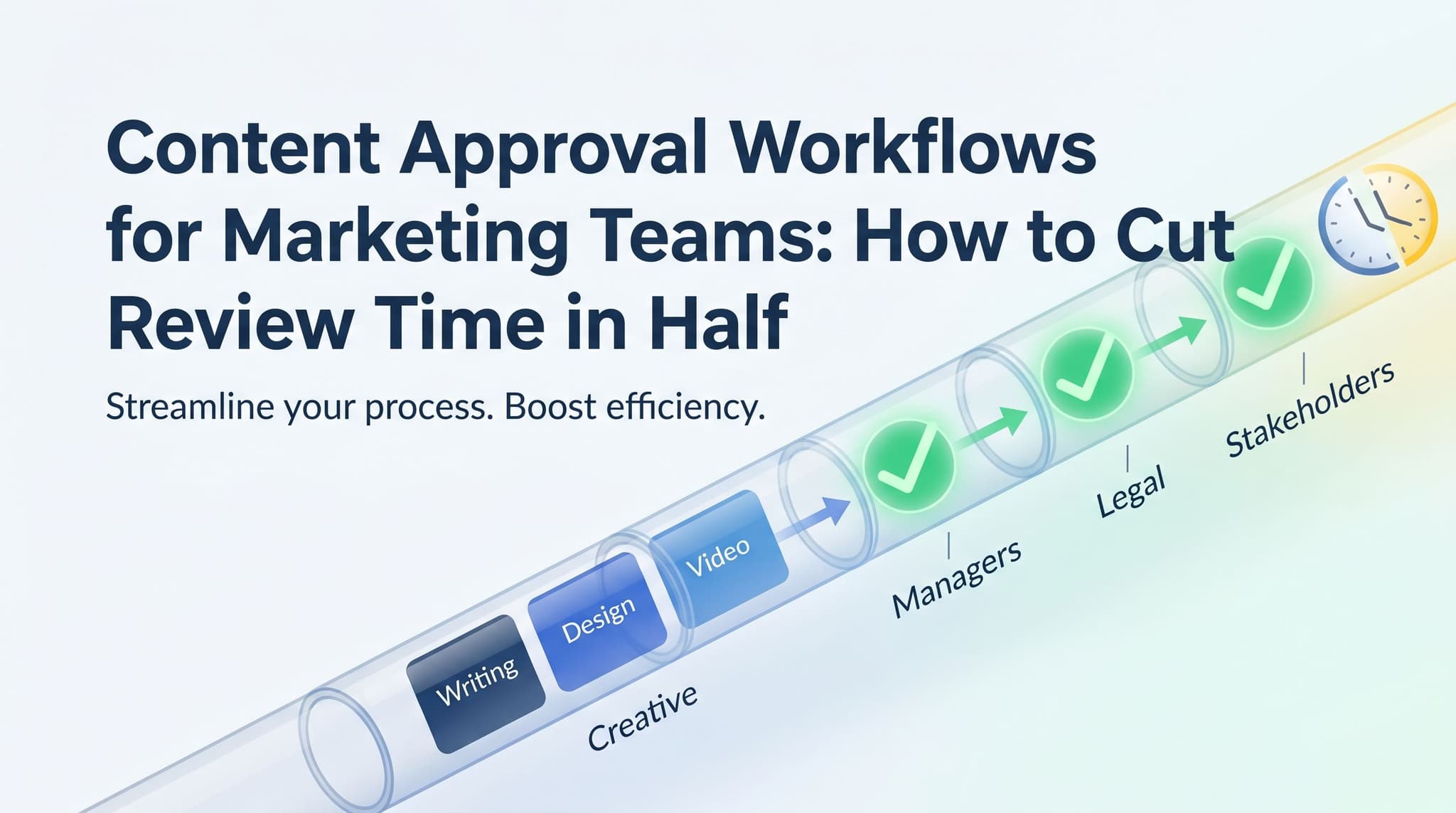
Content Approval Workflows for Marketing Teams: How to Cut Review Time in Half
Most marketing teams don't have a content problem. They have an approval problem. Posts sit in email threads for days. Feedback arrives late. Nobody knows who has the final call. By the time the content is approved, the moment has passed. In 2026, the teams moving fastest aren't working harder on their review process. They're rebuilding it from scratch around a simple idea: AI handles creation and scheduling, and humans make the fast calls. This article breaks down exactly how to build a content approval workflow that doesn't stall, who owns each stage, and why consolidating everything into one tool changes the math entirely. If you manage social media for a team, an agency, or a client roster, this is the workflow shift that will actually stick.
May 13, 2026
Read more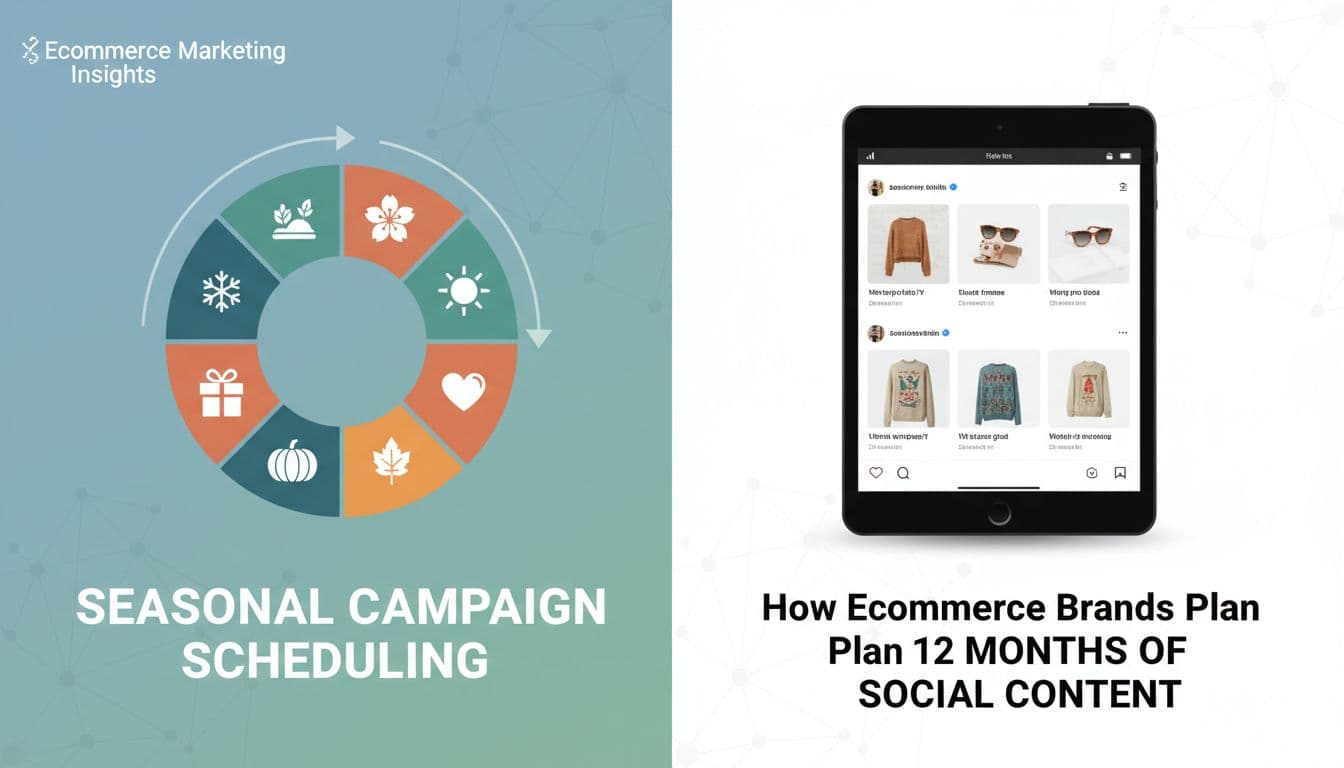
Seasonal Campaign Scheduling: How Ecommerce Brands Plan 12 Months of Social Content
Most ecommerce brands treat social media like a fire drill. A holiday creeps up, someone panics, and three people spend a weekend writing captions that should have been ready weeks ago. The result is rushed content, inconsistent brand voice, and missed revenue windows. There's a better way. Brands that build a real 12-month social media calendar stop reacting and start executing. They map content to the retail calendar, plan platform-specific posts for each season, fill the quiet months that most brands ignore, and build approval workflows that don't collapse under deadline pressure. This article walks through exactly how to do that, and how agentic AI changes the game for small teams that can't afford to hire a full content department. If you've been looking for a system that actually holds up all year, this is it.
Jun 1, 2026
Read moreReady to never miss a post again?
Tell Aidelly what to post. It drafts, schedules, and publishes across 9 platforms while you focus on your business.