Social Media Glossary 2026: 25 Key Terms Every Beginner Should Know
There's a moment that happens to almost everyone starting their social media journey—you're scrolling through a marketing article or sitting in a strategy meeting, and someone casually drops a term like "engagement rate" or "lookalike audiences," and you're left nodding along while internally panicking. Sound familiar?
The truth is, social media marketing has developed its own language, and learning that language isn't just helpful—it's essential. Whether you're managing a small business Instagram account, launching your first TikTok strategy, or transitioning into a digital marketing role, understanding these core terms will transform how you approach your social presence.
This isn't your typical alphabetical glossary that reads like a dictionary. Instead, we've organized 25 essential social media terms by how you'll actually use them—grouped by platform features, metrics you'll track, content strategies you'll build, and the analytics you'll obsess over. By the end, you'll have a solid foundation to navigate social platforms like someone who actually knows what they're doing.
Platform Features & Content Basics: Speaking the Language of Each Network
Before you can master social media marketing, you need to understand the building blocks of each platform. Every network has its own terminology, and what works on Instagram looks completely different on TikTok or Twitter. The features available to you—and the language used to describe them—vary dramatically depending on where your audience hangs out.
Think of this section as your translation guide between platforms. When you understand what a "story" really means, or why "retweets" matter on Twitter but don't exist on Instagram, you'll stop feeling confused and start feeling confident. These aren't just fancy terms—they're the actual tools you'll use to build your content strategy and connect with your audience every single day.
1. Essential Platform-Specific Terminology: Hashtags, Mentions, Retweets, Stories, Reels, and Pins
Let's start with the foundational features that make each platform unique. These aren't complicated concepts, but they're the vocabulary you'll use constantly, so getting them right matters.
Hashtags are those #symbols followed by keywords (like #SmallBusinessOwner or #ContentCreator). They're essentially filing systems for social media. When you use a hashtag, you're categorizing your post so people searching or following that hashtag can discover your content. Think of them as digital Post-it notes that help interested people find you. On Instagram and TikTok, hashtags are crucial—they can dramatically expand your reach beyond just your followers. On Twitter, they're useful but less critical. Pro tip: research hashtags in your niche before you start posting. Don't just use the biggest hashtags; focus on medium-sized ones where there's less competition but genuine interest.
Mentions (the @symbol) are how you tag specific people or brands in your posts and comments. When you mention someone, they get notified, and their username appears as a clickable link. This is incredibly useful for starting conversations, crediting other creators, or getting attention from brands you admire. Mentions create direct connections and can spark engagement—just don't overdo it or you'll look spammy.
Retweets are exclusively a Twitter feature that lets you share someone else's tweet with your followers. It's like saying "hey, this is worth sharing." When you retweet something, it appears on your timeline with their original content intact. This is one of the fastest ways to build credibility on Twitter—retweeting valuable content from industry experts shows you're plugged into conversations happening in your space.
Stories originated on Snapchat but are now available on Instagram, Facebook, and WhatsApp. They're temporary posts (disappearing after 24 hours) that feel more casual and authentic than permanent posts. Stories are perfect for behind-the-scenes content, quick updates, polls, or anything you want to share without the pressure of it being permanent. They typically get higher engagement rates than feed posts because they feel more intimate and real.
Reels are Instagram's answer to TikTok—short-form vertical video content (typically 15-90 seconds) designed to be entertaining and shareable. Reels get prioritized in Instagram's algorithm, which means they tend to reach more people than static posts. If you're serious about Instagram growth in 2026, you need to be creating Reels consistently. They're where the algorithm rewards creators most aggressively right now.
Pins are Pinterest's core feature. They're visual bookmarks (usually images with descriptions) that users save to their boards for later. Unlike most social platforms, Pinterest is less about immediate engagement and more about discovery and inspiration. Pins can drive traffic to your website for months or even years after you post them, making Pinterest incredibly valuable for long-term organic reach.
2. Engagement Metrics & Analytics: Understanding What Your Numbers Actually Mean
Numbers don't lie, but they can definitely confuse beginners. Social media analytics give you concrete data about how your content is performing, but only if you understand what each metric actually represents.
Impressions are the total number of times your content has been seen. This includes people who scrolled past your post, people who saw it multiple times, and everyone in between. Impressions are a vanity metric—they look good on paper, but they don't tell you if people actually cared about your content. You could have 10,000 impressions but zero conversions, which means your reach was wide but your impact was shallow.
Reach is different from impressions. Reach measures the number of unique people who saw your content. If 100 people each saw your post twice, that's 200 impressions but 100 reach. Reach is more meaningful than impressions because it tells you how many distinct humans actually encountered your message. When planning campaigns, reach is typically the more important metric to track.
Engagement Rate is the percentage of people who interacted with your content (likes, comments, shares, clicks) divided by your total reach or followers. It's calculated as: (Total Engagement ÷ Total Followers) × 100. An engagement rate of 3-5% is considered good on most platforms; above 5% is excellent. This metric tells you whether your audience actually cares about what you're posting. High engagement rates mean your content resonates, which is infinitely more valuable than high impressions with low engagement.
Click-Through Rate (CTR) measures the percentage of people who clicked on a link in your post compared to the total number of people who saw it. If your post got 1,000 impressions and 50 people clicked your link, your CTR is 5%. CTR is crucial for any post where you're trying to drive traffic—to your website, landing page, or another platform. It's one of the clearest indicators of whether your content actually persuaded people to take action.
Conversion happens when someone completes a desired action after clicking your content—signing up for your email list, making a purchase, downloading a resource, or scheduling a call. Conversions are the ultimate goal of most social media marketing. You can have amazing reach and engagement, but if it doesn't convert to actual business results, you're just entertaining people. Always track what percentage of your traffic actually converts so you can optimize your strategy accordingly.
3. Content Creation & Posting Concepts: Organic Reach, Algorithms, and Strategic Publishing
Creating content is only half the battle. The other half is understanding how platforms decide whose content gets seen and whose gets buried.
Native Content is content created directly within a social platform rather than copied from elsewhere. A video shot on your phone and uploaded directly to TikTok is native content. That same video downloaded from TikTok and uploaded to Instagram is not native content—it's imported content. Platforms prioritize native content because it keeps users on their platform longer. If you're serious about growth, create content specifically for each platform rather than posting the same thing everywhere.
Organic Reach is the number of people who see your content without paid promotion. It's the "free" reach you earn through the platform's algorithm and your existing followers. Organic reach has been declining on most platforms for years—the algorithms increasingly favor paid content. However, organic reach is still possible if you create genuinely good content that encourages engagement and sharing. Focus on creating content people want to engage with, and organic reach will follow.
Sponsored Posts (also called paid posts or ads) are content you pay the platform to promote. Instead of relying on the algorithm to show your content to people, you're paying for guaranteed visibility. Sponsored posts appear in feeds, stories, and other placements, usually marked with an "Ad" label. For most businesses, a mix of organic and sponsored content is ideal—organic content builds authentic community, while sponsored content accelerates growth and drives conversions.
The Algorithm is the invisible force that decides which posts get shown to which people. Each platform has its own algorithm, but they generally work by analyzing engagement patterns, user behavior, and content quality to predict what each person wants to see. The Instagram algorithm, for example, prioritizes content from accounts you interact with frequently, content that generates quick engagement, and content that keeps you on the app longer. Understanding your platform's algorithm is key to growth. In 2026, most algorithms reward: engagement (likes, comments, shares), watch time (how long people watch your videos), saves (bookmarking content), and shares (the most powerful engagement signal).
Community Building & Audience Strategy: Creating Connections That Matter
Social media isn't about broadcasting to a faceless crowd—it's about building a community of people who genuinely care about what you're doing. This section covers the terminology around audience building, from basic follower counts to sophisticated influencer partnerships.
Understanding these terms is crucial because they shift your mindset from "how many followers can I get?" to "what kind of community am I building and how do I nurture it?" The difference matters enormously. A small, engaged community of 5,000 followers will drive more business results than a large, disengaged audience of 50,000. These terms help you think strategically about who you're trying to reach and how to build meaningful relationships with them.
4. Community Management Terminology: Followers, Influencers, Brand Ambassadors, and User-Generated Content
Followers are people who have chosen to subscribe to your account so they see your content in their feed. Follower count is often seen as a status symbol, but here's the truth: quality matters infinitely more than quantity. 1,000 followers who love your content and engage regularly are worth far more than 100,000 disengaged followers. When building your following, focus on attracting the right people—people who are genuinely interested in what you offer. Growth will be slower initially, but your community will be stronger and more profitable.
Influencers are content creators or personalities with large, engaged followings who can influence purchasing decisions and opinions. They're not just people with big numbers—true influencers have earned trust and credibility with their audience. There are different tiers: mega-influencers (1M+ followers), macro-influencers (100K-1M followers), micro-influencers (10K-100K followers), and nano-influencers (1K-10K followers). For most small businesses, partnering with micro or nano-influencers in your niche delivers better ROI than chasing mega-influencers. These smaller creators often have more engaged audiences and charge less for partnerships.
Brand Ambassadors are loyal customers or followers who actively promote your brand because they genuinely love it. Unlike paid influencer partnerships, brand ambassadors typically do this organically or for discounts and perks. They're your most valuable marketing asset because they're authentic advocates. The best way to create brand ambassadors? Deliver exceptional products or services, then make it easy for happy customers to share their experience. Give them exclusive perks, feature their content, and thank them publicly.
User-Generated Content (UGC) is any content created by your customers or audience rather than by you. This could be reviews, photos of them using your product, testimonials, or videos featuring your brand. UGC is incredibly powerful because it's authentic and trusted. When potential customers see real people (not just your marketing team) endorsing your product, they're far more likely to buy. Encourage UGC by creating branded hashtags, running contests, or simply asking customers to share their experience. Then feature that content on your own accounts—it builds community and provides a steady stream of authentic content.
5. Advertising and Monetization Terms: Understanding the Economics of Paid Social
If you're serious about scaling your social media presence, you'll eventually invest in paid advertising. These terms describe how that investment works and how platforms charge you for visibility.
CPC (Cost Per Click) is exactly what it sounds like: you pay each time someone clicks on your ad. If your CPC is $0.50 and 100 people click your ad, you pay $50. CPC-based campaigns are ideal when your goal is driving traffic to a website or landing page. You only pay for actual clicks, which makes it feel more efficient than paying for impressions you're not sure anyone noticed.
CPM (Cost Per Mille) means you pay for every 1,000 impressions your ad receives, regardless of whether anyone clicks it. If your CPM is $5 and your ad gets 10,000 impressions, you pay $50. CPM is useful for brand awareness campaigns where your goal is visibility rather than clicks. It's typically cheaper per impression than CPC, but you're paying for views whether people engage or not.
CPA (Cost Per Action) is the most results-focused pricing model. You only pay when someone completes a specific action—a purchase, sign-up, download, or whatever you define as valuable. CPA campaigns are ideal for direct response marketing because you're only paying for actual results. However, they're typically more expensive per action than CPC or CPM because the platform is taking on more risk.
Retargeting (also called remarketing) shows ads to people who have already visited your website or engaged with your content but didn't convert. It's like following someone around the internet with your message. Retargeting is incredibly effective because you're targeting warm leads—people who already know you exist and have shown interest. Someone who visits your website but doesn't buy is far more likely to convert through a retargeting ad than a cold prospect. Most successful campaigns include a retargeting component.
Lookalike Audiences are created when you upload your customer list or best customers to an ad platform, and the platform finds people similar to them. Facebook's lookalike audiences, for example, analyze what your best customers have in common and find other users with similar characteristics. Lookalike audiences are powerful because they let you scale beyond your existing customer base by finding new people likely to be interested in what you offer. They're especially useful after you've built initial traction and want to accelerate growth.
6. Content Formats and Features: Choosing the Right Format for Your Message
Different messages require different formats. Understanding the strengths of each content type helps you choose the right tool for your specific goal.
Carousel Posts are multi-image or multi-video posts where viewers can swipe between different slides. On Instagram, you can include up to 10 images or videos in one carousel. Carousels are fantastic for storytelling, product showcases, or educational content. They get higher engagement than single-image posts because people are more likely to swipe through interesting content. Use carousels when you have multiple related images to share—before/after transformations, step-by-step tutorials, or product variations.
Live Streaming is broadcasting video content in real-time to your audience. Available on Instagram, Facebook, TikTok, and YouTube, live streams create urgency and authenticity. People tune in specifically to watch you in real-time, ask questions, and interact. Live streams typically get more engagement and reach than pre-recorded videos because the algorithm pushes them to more people (platforms want to create live viewers). Use live streaming for Q&A sessions, product launches, behind-the-scenes tours, or any time you want to feel more personal and authentic.
Infographics are visual representations of data or information designed to be easily understood at a glance. They combine images, text, icons, and charts to explain complex concepts simply. Infographics are incredibly shareable because they provide value in a format that's easy to consume and save. On Pinterest especially, infographics perform exceptionally well. Create infographics when you want to explain processes, share statistics, or provide educational content in a visually appealing way.
Memes are humorous, relatable content that spreads because people want to share them. They can be images with text, videos, or screenshots. Memes humanize your brand and make it relatable. If your audience is younger or your brand voice is casual, memes can be incredibly effective. Just make sure they're relevant to your brand and audience—forced memes look inauthentic and can backfire.
Threads are a series of connected posts (typically on Twitter/X) that tell a complete story or explore a topic in depth. The first tweet introduces the topic, and each subsequent tweet (numbered 1/n, 2/n, etc.) adds more information. Threads are perfect for sharing expertise, telling stories, or breaking down complex topics. They often perform better than single tweets because they encourage people to engage with multiple posts. If you have something substantial to share, a thread is often more effective than a single post.
Strategy, Analytics & Crisis Management: Building a Sustainable Social Media Presence
Having great content and understanding platform features is important, but sustainable success requires strategy, measurement, and the ability to handle challenges. This final section covers the planning and analysis tools you'll use to make decisions, plus the terminology around managing your reputation when things go wrong.
These terms represent the difference between random posting and intentional strategy. When you understand KPIs, buyer personas, and attribution, you stop guessing whether your efforts are working. When you understand shadow banning and cancel culture, you're prepared to protect your reputation. These aren't just buzzwords—they're the frameworks that separate successful social media presence from unsuccessful ones.
7. Strategy and Planning Terminology: Building Your Roadmap to Success
Content Calendar is a planning document (spreadsheet, tool, or app) where you schedule and organize your social media posts in advance. It typically shows what you'll post, when you'll post it, which platform, what format, and sometimes performance goals. A content calendar keeps you organized, ensures consistent posting, and prevents the "what should I post today?" panic. Most successful social media managers plan content at least 2-4 weeks in advance. Tools like Buffer, Later, or even a simple Google Sheet work fine—what matters is having a plan.
Buyer Persona is a semi-fictional representation of your ideal customer based on research and data. It includes demographics (age, location, income), psychographics (values, interests, pain points), goals, and challenges. Creating detailed buyer personas helps you create content that actually resonates with your audience. Instead of posting generic content hoping someone cares, you're creating content specifically for the person you're trying to reach. Spend time developing 2-3 detailed buyer personas before you start building your social strategy.
A/B Testing (also called split testing) is comparing two versions of something to see which performs better. You might test different headlines, images, posting times, or CTAs. With A/B testing, you change one variable while keeping everything else the same, then measure which version gets better results. A/B testing removes guesswork from social media strategy. Instead of debating whether a post should say "Learn More" or "Get Started," you test both and let the data decide. The more you test, the more you optimize your approach.
KPIs (Key Performance Indicators) are the specific metrics you track to measure success. For a solopreneur, KPIs might be follower growth and website traffic. For an e-commerce brand, KPIs might be conversion rate and average order value. For a content creator, KPIs might be watch time and engagement rate. Define your KPIs based on your actual business goals, not vanity metrics. If your goal is sales, track conversions and revenue, not just follower count. Every post and campaign should move your KPIs in the right direction.
8. Emerging Platform Features: Staying Current in 2026
Stories (covered briefly earlier) deserve deeper exploration because they've become essential across multiple platforms. Originally from Snapchat, Stories are now core features on Instagram, Facebook, WhatsApp, and even LinkedIn. In 2026, Stories are increasingly important because they feel authentic and less polished than feed posts. People expect Stories to be raw, unfiltered, and personal. They're perfect for daily updates, behind-the-scenes content, and building parasocial relationships with your audience. Stories also provide valuable analytics about who viewed them and when they dropped off.
Reels continue to dominate in 2026. Instagram's algorithm heavily favors Reels, and TikTok's influence on social media culture means short-form video is no longer optional—it's essential. Reels that go viral can reach millions of people organically. The key to Reel success is understanding the platform's algorithm: hook viewers in the first second, keep them watching until the end, and encourage saves/shares/comments. Reels perform best when they're entertaining, educational, or inspiring—not salesy.
TikTok Trends are challenges, sounds, and formats that go viral on TikTok and often spread to other platforms. Participating in trends (when they align with your brand) is one of the fastest ways to gain visibility. The challenge is that trends move incredibly fast—a trend that's hot this week might be dead next week. Monitor what's trending in your niche, and participate when it makes sense. Don't force it though; inauthentic trend participation looks desperate and gets ignored.
Discord Communities represent a shift in how brands build community. Discord started as a gaming platform but has evolved into a space where creators and brands build engaged communities. Unlike social media platforms where the algorithm controls visibility, Discord communities are owned by you. Members opt in and stay engaged because they genuinely want to be part of the community. For creators and brands building loyal audiences, Discord communities are becoming increasingly important as a way to deepen relationships and create exclusive spaces.
BeReal is an emerging platform focused on authenticity—it sends random notifications encouraging users to share unfiltered photos of what they're doing in that exact moment. While still niche, BeReal represents a broader trend toward authenticity and less-polished content. For brands, BeReal isn't yet essential, but understanding this trend toward authenticity matters. Your audience increasingly values genuine, unfiltered content over perfectly polished marketing. This affects how you should approach content across all platforms.
9. Crisis Management and Moderation Terms: Protecting Your Reputation
Shadow Banning happens when a platform restricts your content's visibility without explicitly telling you. Your posts might still be visible to your followers, but they won't appear in hashtag searches or on the Explore/Discovery pages. Shadow banning usually results from violating community guidelines (often accidentally), posting too much promotional content, or using banned hashtags. It's frustrating because you don't get a notification—you just notice your engagement dropping mysteriously. To avoid shadow banning, follow community guidelines carefully, avoid spammy behavior, and regularly audit your hashtags to ensure they're not banned.
Ratio is when a post gets far more replies than likes or engagement, usually because people are criticizing or mocking the post. Being "ratioed" on Twitter is embarrassing and can damage your reputation. It typically happens when you say something controversial, tone-deaf, or just plain wrong. The best way to avoid being ratioed? Think before you post. Read your caption out loud. Ask yourself if you'd say this in front of your actual customers. If you do get ratioed, don't panic—delete the post, acknowledge the issue, and move on. Don't argue with people in the replies.
Cancel Culture refers to when large groups of people withdraw support from someone or a brand due to controversial statements or actions. Being "cancelled" can damage your reputation and business. In 2026, cancel culture remains powerful, especially on Twitter and TikTok. To protect yourself: be authentic but thoughtful, avoid making inflammatory statements about politics or social issues unless it's core to your brand, and own mistakes quickly and genuinely if you mess up. Most cancellations fade if you respond with genuine accountability rather than defensiveness.
Community Guidelines are the rules each platform sets for acceptable behavior and content. They typically prohibit hate speech, harassment, misinformation, illegal content, and spam. Violating community guidelines can result in content removal, account suspension, or permanent banning. Read your platform's community guidelines thoroughly—ignorance isn't a defense. What's acceptable on one platform might violate another's guidelines. When in doubt, err on the side of being respectful and truthful.
10. Analytics and Measurement Terms: Understanding Your Data
Bounce Rate measures the percentage of people who visit a page and leave without taking any action or exploring further. If someone clicks your Instagram link, lands on your website, and immediately leaves without scrolling or clicking anything, that's a bounce. High bounce rates suggest either your traffic source isn't aligned with your landing page content, or your landing page isn't compelling enough. Track bounce rate for traffic coming from social media to ensure you're sending people to pages relevant to what they clicked on. If you're driving people to a specific offer, make sure your landing page clearly explains that offer.
Session Duration measures how long someone spends on a page or website during a single visit. Longer sessions generally indicate more engagement and interest. When analyzing social media traffic, session duration helps you understand whether your audience is just clicking and leaving, or actually exploring your content. If your session duration is very short, it might mean your website isn't engaging, your pages load slowly, or you're attracting the wrong audience. Improve this by making your website more engaging, ensuring fast load times, and sending traffic from social media to highly relevant pages.
Attribution is assigning credit for a conversion to the source that drove it. If someone clicks your Instagram post, visits your website, leaves, comes back the next day through a Google search, and buys—which channel gets credit? Attribution modeling helps answer this question. Last-click attribution (giving credit to the last click) is common but often unfair—Instagram deserves some credit for the initial discovery. Multi-touch attribution gives credit to all touchpoints. Understanding attribution helps you allocate your marketing budget correctly. If Instagram is driving awareness that eventually converts through search, you need to account for that when evaluating Instagram's ROI.
Viral Coefficient measures how many new users each existing user brings to your platform or product through sharing. A viral coefficient above 1 means each user brings more than one new user, causing exponential growth. A viral coefficient below 1 means growth eventually plateaus. This matters because it tells you whether your content is naturally spreading. Content that goes viral has a high viral coefficient—people are sharing it so much that it reaches far beyond your audience. Most content has a viral coefficient below 1, which is why consistent posting and paid promotion matter. However, occasionally creating content with high viral potential can dramatically accelerate growth.
Learning social media terminology might seem overwhelming at first, but these 25 terms represent the foundation of everything you'll do as a social media marketer. From understanding how platforms work (Stories, Reels, Pins) to measuring what matters (engagement rate, conversion, KPIs), to protecting your reputation (community guidelines, shadow banning), you now have the vocabulary to navigate this space confidently.
The beauty of mastering this terminology is that it transforms how you approach social media. Instead of randomly posting content and hoping something sticks, you'll be intentional—creating a content calendar aligned with your buyer personas, testing different approaches with A/B testing, and measuring everything against clear KPIs. You'll understand why organic reach matters less than engagement rate, and why a small community of brand ambassadors is worth more than thousands of passive followers.
As you build your social media presence, remember that these terms aren't just vocabulary—they're tools for strategic thinking. The more fluent you become in this language, the more effectively you can analyze what's working, adjust your approach, and build genuine connections with your audience. Your social media presence is a direct reflection of your business, so it's worth getting right.
If you want a low-lift way to apply these ideas, Aidelly helps you keep your social content consistent without extra busywork. Now that you're fluent in social media terminology, the real challenge is putting it all into practice—consistently creating content that resonates, tracking the metrics that matter, and keeping your brand voice steady across multiple platforms without burning out. That's where Aidelly comes in: our platform makes it simple to create and schedule engaging content effortlessly while ensuring your brand stays recognizable and authentic, no matter which channel your audience is on. Ready to transform all this knowledge into real results? Get started at aidelly.ai.Compare Social Scheduling Tools
Evaluating software for your content workflow? Use our buyer guides and comparisons to compare scheduling, approvals, analytics, and AI workflow fit.
Share this article
Related Articles
7 Must-Have Social Media Management Tools for Small Businesses in 2026: A Real-World Cost-Benefit Guide
Running a small business in 2026 means juggling multiple social media accounts without a dedicated team—or budget. The right social media management tool can save you 10+ hours per week while actually improving your engagement and ROI. This guide breaks down the best affordable tools for small business owners, from scheduling platforms to design solutions, with honest cost-benefit analysis and a decision tree to help you pick the perfect fit for your specific needs and budget.
Jan 28, 2026
Read more
Social Media Automation: A Beginner's Guide to Saving Time Without Losing Your Human Touch (2026)
Tired of spending hours managing social media? Social media automation can be a game-changer for small business owners and solopreneurs, but it's not about replacing genuine connection—it's about being smarter with your time. In this comprehensive guide, we'll explore what automation actually is, why it matters, the tools that work best, and most importantly, how to use it without coming across as robotic or inauthentic. Learn the automation paradox: how strategic automation actually frees you up to have MORE meaningful conversations with your audience.
Jan 27, 2026
Read more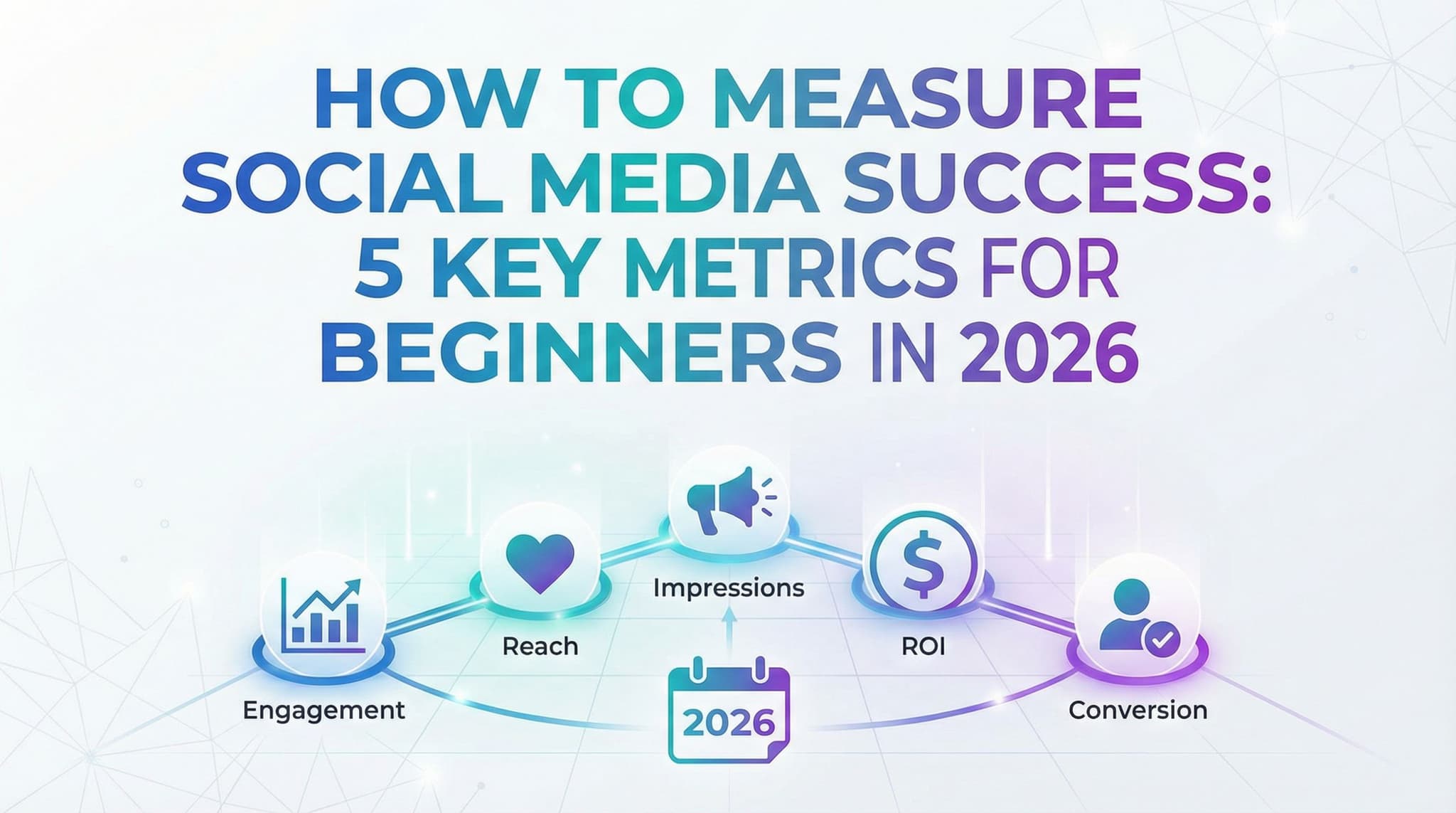
How to Measure Social Media Success: 5 Key Metrics for Beginners in 2026
Stop obsessing over vanity metrics and start measuring what actually matters for your business. This practical guide walks you through the essential social media KPIs that connect directly to real results—whether you're a solopreneur, small business owner, or marketing student. Learn which metrics to track at different growth stages, how to calculate them yourself, and why the 'right' metrics depend entirely on your business goals, not universal rules.
Jan 28, 2026
Read moreReady to never miss a post again?
Tell Aidelly what to post. It drafts, schedules, and publishes across 9 platforms while you focus on your business.