Cross-Posting on Social Media in 2026: Smart Strategies vs. Lazy Shortcuts for Beginners
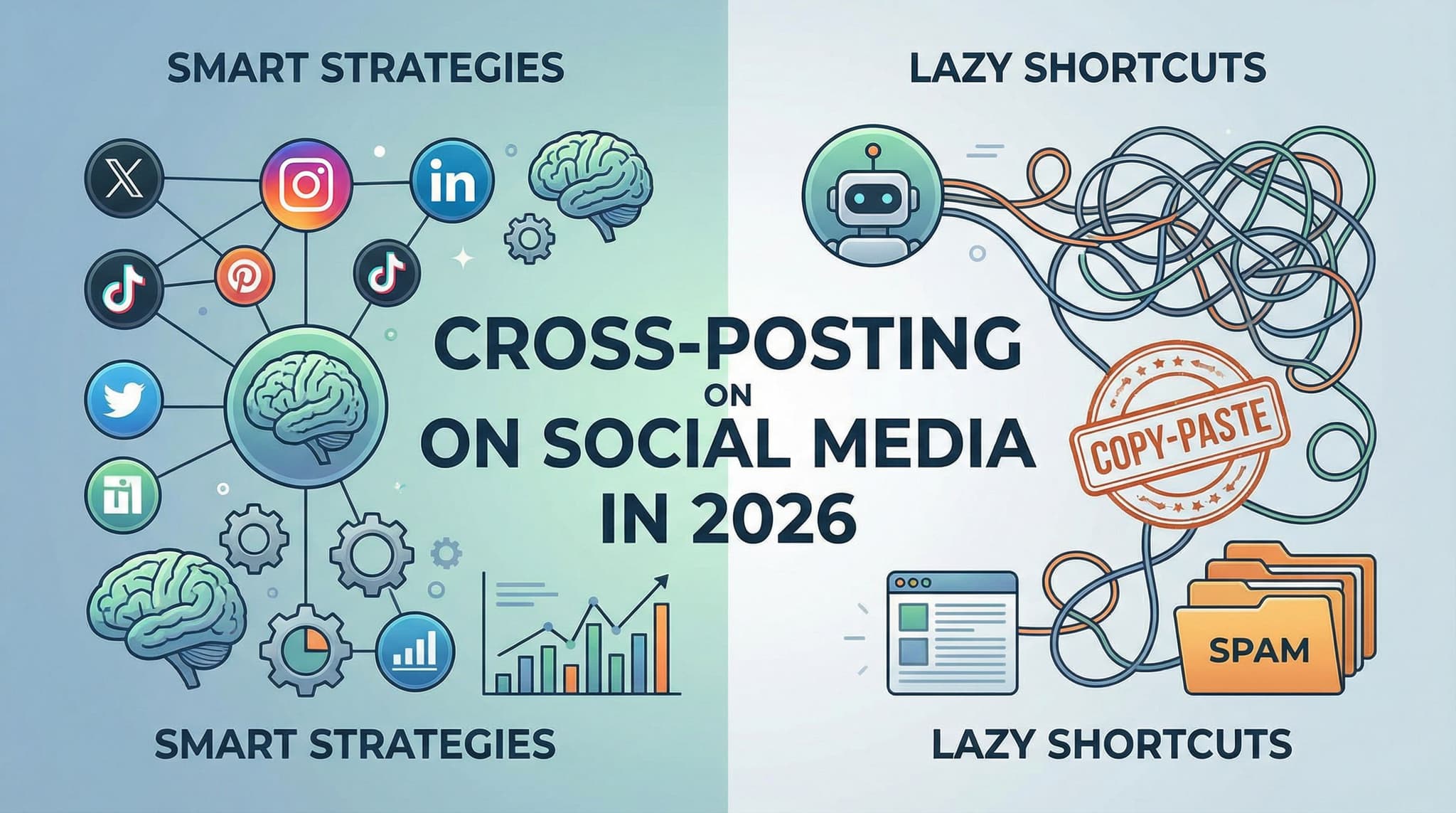
Let's be honest: managing multiple social media accounts is exhausting. Between crafting captions, scheduling posts, responding to comments, and analyzing metrics, it's easy to see why the idea of cross-posting everything everywhere feels like a lifeline. And yes, there's real value in that instinct—cross-posting absolutely can save you time and resources when done intelligently. But here's where most beginners go wrong: they confuse efficiency with effectiveness.
Picture this scenario: You spend an hour crafting the perfect LinkedIn post about your new service offering. It's professional, detailed, and includes a compelling call-to-action. Then you copy-paste it directly to Instagram, TikTok, and Twitter without changing a single word. The LinkedIn version gets decent engagement. The Instagram post? Crickets. The TikTok? Even worse. The Twitter version gets lost in the noise within minutes.
This is the cross-posting paradox that catches most small business owners and freelancers off guard. The platforms you're trying to reach aren't interchangeable—they're fundamentally different ecosystems with different audiences, algorithms, content formats, and cultural norms. What thrives on one platform can absolutely flop on another, even if the core message is solid.
The good news? Cross-posting doesn't have to be an all-or-nothing gamble. The real power lies in what we call "smart cross-posting"—being strategic about which content gets distributed where, and more importantly, how you customize that content for each platform's unique personality. This guide will teach you exactly how to do that, even if you're completely new to multi-platform strategies.
Section 1: Understanding the Cross-Posting Paradox—Time Savings vs. Engagement Reality
When you first start managing multiple social media accounts, the math seems simple: if you post once and reach five platforms, you're multiplying your audience exposure by five. That's the seductive logic behind cross-posting, and it's not entirely wrong. The efficiency gains are real, and they matter, especially when you're bootstrapping your business and every hour counts.
But the engagement math tells a different story entirely. And that's what separates entrepreneurs who use cross-posting as a strategic tool from those who use it as a crutch.
1.1: How Cross-Posting Saves Time and Resources (When Done Right)
Let's start with the legitimate advantage: cross-posting genuinely does save time. For a freelancer juggling client work and content creation, or a small business owner wearing ten different hats, those time savings are tangible and valuable.
Consider the mechanics. Without cross-posting, you're looking at a workflow like this: write content for LinkedIn (30 minutes), format it for LinkedIn best practices (10 minutes), post and engage (20 minutes). Then repeat the entire process for Instagram (30 minutes), Twitter (20 minutes), and TikTok (40 minutes because video requires different considerations). That's roughly two and a half hours for one piece of core content distributed across four platforms.
With smart cross-posting, you can compress this significantly. You write once (30 minutes), then spend 10-15 minutes per platform adapting the core message rather than starting from scratch. Suddenly, you're down to maybe 90 minutes total. That's a meaningful time investment you can redirect toward creating more content, engaging with your community, or actually running your business.
Beyond time, there's resource efficiency. Content creation—whether that's photography, videography, copywriting, or design—is expensive. If you can repurpose a single piece of content across multiple channels, you're stretching your content budget further. One well-researched article can become a LinkedIn post, a Twitter thread, an Instagram carousel, and a TikTok series. One customer success story can be adapted into multiple formats and platforms. This approach to content repurposing is especially valuable for beginners operating on tight budgets.
Automation tools like Buffer, Hootsuite, and Later amplify these time savings by letting you schedule posts across multiple platforms from a single dashboard. Instead of logging into each platform individually, you can batch-create and schedule your content for the entire week in one focused work session. For a freelancer with three client accounts to manage, this kind of efficiency multiplier is genuinely transformative.
1.2: The Hidden Cost of One-Size-Fits-All Content Distribution
Here's what most social media guides gloss over: the time you save on posting can evaporate in lost engagement and reach. And sometimes, it disappears entirely.
Each social platform operates on a distinct algorithm designed to surface content that performs well within that specific ecosystem. LinkedIn's algorithm prioritizes posts that generate meaningful comments and shares within the first hour. Instagram's algorithm cares about saves and shares, plus how long people linger on your post. TikTok's algorithm is obsessed with watch time and completion rate. Twitter's algorithm values retweets, replies, and engagement velocity. These aren't just different metrics—they're fundamentally different measures of what "good" content looks like.
When you cross-post identical content without adaptation, you're essentially ignoring these algorithmic realities. A 2,000-word detailed LinkedIn post about your industry expertise might be exactly what your professional audience wants. But that same 2,000-word block of text on Instagram? It's a guaranteed engagement killer. People scroll past walls of text on Instagram. They come for visual content, not essays. Similarly, a casual, emoji-heavy Twitter post might feel out of place on LinkedIn, where your audience expects a more formal professional tone.
The result is predictable: decreased reach and engagement because the platform's algorithm doesn't recognize your content as high-quality for that specific environment. You've optimized for distribution efficiency, but you've sacrificed performance effectiveness. Over time, as the algorithm learns that your content doesn't perform well on certain platforms, it stops showing it to people in the first place.
This is why we call it "lazy cross-posting," and it's where most beginners accidentally sabotage themselves. They save an hour here but lose thousands in potential reach and engagement there.
1.3: The Smart Cross-Posting Framework—Knowing What to Duplicate and What to Customize
So how do you capture the time-saving benefits of cross-posting without sacrificing engagement? The answer is selectivity combined with strategic customization.
Not all content is created equal when it comes to cross-posting potential. Some content types are genuinely "platform-agnostic" in the sense that they can maintain their core message across channels with relatively minor adjustments. Other content types are deeply platform-specific and absolutely require customization, or shouldn't be cross-posted at all.
Here's a practical decision matrix: Evergreen content—tips, how-tos, industry insights, and foundational knowledge—typically cross-posts well. An article about "5 Common Mistakes Freelancers Make" can be adapted for LinkedIn, Twitter, Instagram, and TikTok because the core value proposition remains consistent. The message adapts, but the substance doesn't.
Announcements and major updates also cross-post effectively. Launching a new product, opening applications for a service, or sharing big company news? That's cross-posting gold. The announcement itself is platform-agnostic; you're just changing the wrapper it comes in.
Blog promotions are another strong cross-posting candidate. You've invested time in writing something valuable. Sharing it across multiple platforms makes sense—you're just adjusting the angle and format for each audience.
Where cross-posting breaks down is with trending content, platform-specific features, and highly audience-specific material. A meme that's hilarious on Twitter might be tone-deaf on LinkedIn. A TikTok trend that works for your audience might not translate to Instagram. Commentary on current events might need completely different framing depending on the platform's political and cultural climate.
The framework is this: Ask yourself three questions before cross-posting. First, is this content evergreen or trend-dependent? Second, does it require platform-specific formatting or context to make sense? Third, is my audience on this platform expecting this type of content? If you answer "evergreen," "minimal formatting," and "yes" to all three, you've got a cross-posting candidate. If you answer "no" to any of them, it's time to customize or skip that platform entirely.
Section 2: Platform Architecture—Why LinkedIn, Instagram, TikTok, and Twitter Aren't Interchangeable
This is the core insight that separates effective social media managers from those who struggle: each major platform is a completely different medium with different audiences, different algorithmic priorities, and different cultural norms. Treating them as interchangeable distribution channels is like treating a newspaper, a radio station, and a billboard as the same advertising medium. They're not.
The platforms might look similar on the surface—they all have posts, comments, shares, and engagement metrics. But beneath that surface similarity, they're fundamentally different environments that reward different types of content and communication styles.
2.1: Platform-Specific Audience, Algorithm, and Content Format Realities
Let's walk through each major platform and understand what makes them different. This isn't just theoretical—this directly impacts how you should approach cross-posting.
LinkedIn is fundamentally a professional networking platform where people go to share industry insights, career updates, and business thought leadership. The audience expects formality and substance. LinkedIn's algorithm rewards posts that generate meaningful conversation—specifically, comments that are longer than one or two words. A post that gets 50 thoughtful comments will outperform a post that gets 500 likes. The platform prioritizes depth over virality.
The content format that works best on LinkedIn is typically longer-form: 150-300 word posts with clear value propositions, personal anecdotes that connect to professional insights, and calls-to-action that invite discussion. Videos perform well, but they're usually professional in nature. Casual, emoji-heavy content feels out of place. If you're sharing a blog post on LinkedIn, the excerpt should emphasize the professional value and industry relevance.
Instagram is a visual-first platform where people come for inspiration, lifestyle content, and community connection. The algorithm cares about saves and shares more than likes. A post that gets saved is a signal that someone found it valuable enough to reference later—that's algorithmically gold. Instagram also prioritizes watch time on Reels (their short-form video feature), which means video content gets preferential treatment.
The content format that works on Instagram is visual and concise. A 2,000-word LinkedIn post becomes a 5-slide carousel with short, punchy text on each slide, or a series of Reels. Captions should be engaging but don't need to be essay-length. Emojis and visual hierarchy matter. The platform rewards consistency and aesthetic cohesion—people follow Instagram accounts because they like the overall visual vibe, not just individual posts.
TikTok is entertainment-first, where people come to be surprised, entertained, and engaged. The algorithm is ruthlessly focused on watch time and completion rate. If someone watches your entire 15-second video, that's a massive algorithmic signal. If they skip after 3 seconds, that's a negative signal. TikTok doesn't care about your follower count—it will show your content to people who don't follow you if the algorithm thinks they'll engage with it.
The content format that works on TikTok is authentic, fast-paced, and often slightly chaotic. Highly polished, corporate content feels out of place. TikTok audiences reward personality, humor, and relatability. Trending sounds and effects matter. A professional LinkedIn post translated directly to TikTok would flop spectacularly. But a behind-the-scenes glimpse of your work process, a quick tip delivered with personality, or a relatable industry frustration? That's TikTok gold.
Twitter is a real-time conversation platform where people come for news, commentary, and quick takes. The algorithm rewards engagement velocity—how quickly a tweet generates retweets, replies, and likes in the first few minutes. A tweet that gets 100 engagements in the first hour will be shown to more people. The content format is short, snappy, and often opinionated. Threads (connected tweets) allow for longer content, but individual tweets should be punchy.
Twitter audiences expect personality and sometimes humor. Overly formal or sales-y content gets ratio'd (meaning replies outnumber likes, usually because people are criticizing you). The platform is great for real-time commentary, industry hot takes, and quick tips. A long, formal LinkedIn post doesn't work here. But a provocative question, a hot take on an industry trend, or a quick tip in a thread? Perfect.
Here's the critical insight: these aren't just stylistic differences. They're fundamental differences in how the platforms surface content and what their audiences are seeking. When you cross-post identical content, you're ignoring these realities and essentially telling each platform's algorithm "I don't understand how you work."
2.2: Why One-Size-Fits-All Posting Reduces Effectiveness Across the Board
Let's look at a concrete example of what happens when you ignore platform differences. Imagine you're a business coach who just published a comprehensive guide on "How to Scale Your Freelance Business from $50K to $250K Annually."
You write a detailed LinkedIn post: "Excited to share my latest guide on scaling a freelance business. After working with 50+ freelancers, I've identified the three key phases of growth. Here's what I learned... [2,000 words of detailed insights]." This post gets solid engagement on LinkedIn because your professional audience is there specifically for this type of detailed, substantive content.
Then you copy-paste the exact same post to Instagram. Immediately, you've made a mistake. Instagram users scroll past long text blocks. The algorithm doesn't recognize this as high-quality Instagram content because it violates the platform's content format expectations. You get minimal engagement, which tells Instagram's algorithm that this content isn't working. It shows the post to fewer and fewer people.
You copy-paste to TikTok as well, and now you've really made a mistake. A 2,000-word text post on TikTok is nonsensical. The platform expects video. The algorithm doesn't even know what to do with this content. It gets buried immediately.
On Twitter, you paste the same text and watch it disappear in minutes. Twitter's algorithm is built for real-time conversation and engagement velocity. A long, formal post doesn't generate the quick engagement that signals quality content to the algorithm.
The result? You've created one strong piece of content (the LinkedIn version) and three weak versions of it. You've wasted the opportunity to reach different audiences with content specifically designed for them. And you've signaled to three separate algorithms that you don't understand how their platforms work.
This is why one-size-fits-all posting is so insidious—it looks efficient on the surface (one post, four platforms), but it's actually deeply inefficient because you're leaving massive engagement and reach on the table.
2.3: Platform-Specific Content Templates and Adaptation Examples
Let's get practical. Here's how to take that freelance business scaling guide and adapt it for each platform without rewriting from scratch.
LinkedIn Adaptation Template:
Hook (first 1-2 sentences): Personal anecdote or surprising statistic that establishes credibility. Example: "I've worked with 50+ freelancers over the past 3 years. The ones who hit $250K+ annual revenue all shared one thing in common..."
Value proposition (next 2-3 sentences): What's the core insight? Example: "There are three distinct phases of freelance scaling, and most people get stuck in phase two because they're still operating like they're in phase one."
The three phases (roughly 150-200 words total): Brief explanation of each phase with a relatable example.
Call to action: Invite discussion. "What phase are you in right now? Reply in the comments—I want to hear your experience."
Instagram Adaptation Template:
Instead of one long post, create a 5-slide carousel. Slide 1: Eye-catching visual with a question ("How much are you leaving on the table?"). Slide 2: Phase 1 explained in 1-2 sentences with a visual or icon. Slide 3: Phase 2 explained similarly. Slide 4: Phase 3 explained similarly. Slide 5: Call to action with a link to the full guide in your bio.
Caption: 100-150 words, conversational tone. "Scaling a freelance business isn't just about working harder. It's about evolving your business model as you grow. Swipe through to see the three phases..."
TikTok Adaptation Template:
Create a series of 3-5 short videos, each 15-30 seconds. Video 1: "The biggest mistake freelancers make when scaling" (hook, establish the problem). Video 2: "Phase 1 of scaling looks like this" (quick visual examples, maybe B-roll of you working). Video 3: "Phase 2 is where most people get stuck" (relatable commentary, maybe with text overlays). Video 4: "Phase 3 is when everything changes" (energetic, show the results). Video 5: "Link in bio for the full breakdown."
Tone: Conversational, personality-driven, sometimes humorous. Use trending sounds if they fit.
Twitter Adaptation Template:
Create a thread. Tweet 1: "Spent 3 years helping 50+ freelancers scale to $250K+. There are 3 distinct phases most people go through. Here's what I learned... 🧵" Tweet 2: "Phase 1: The Doer. You're trading time for money. Every dollar you make is directly tied to hours you work. This is necessary, but it's a ceiling." Tweet 3: "Phase 2: The Bottleneck. You have more clients than you can handle. You're raising rates, getting selective, but you're still the limiting factor..." And so on.
Tone: Conversational but punchy. Use line breaks and emojis strategically. Each tweet should be interesting enough to stand alone.
Notice what's happening here: the core insight (three phases of scaling) stays consistent. But the format, length, tone, and visual presentation changes dramatically for each platform. This is smart cross-posting—you're using the same foundational content but customizing it for each platform's unique environment.
Section 3: Execution—Tools, Timing, Analytics, and the Metrics That Actually Matter
Now we get to the practical execution layer: how to actually implement smart cross-posting without losing your mind managing five different platforms. This is where automation tools become genuinely valuable, but also where most beginners make critical mistakes in how they use them.
The key principle here is that automation tools should enhance your strategy, not replace platform intelligence. They're the vehicle that gets you where you want to go, but you still need to be the driver who understands the road ahead.
3.1: Using Automation Tools Strategically (Without Becoming Lazy)
Buffer, Hootsuite, and Later have become standard tools for multi-platform posting, and for good reason. They solve a real problem: managing multiple platforms from a single dashboard is genuinely easier than logging into each platform individually. But there's a critical distinction between using these tools strategically and using them as a crutch for lazy cross-posting.
What These Tools Do Well:
Batch scheduling is the legitimate superpower of automation tools. Instead of posting one thing at a time, you can spend 90 minutes on a Tuesday morning creating and scheduling your content for the entire week. You write your LinkedIn post, schedule it for Tuesday at 8 AM when your professional audience is most active. You adapt it for Instagram, schedule it for Wednesday at 6 PM when your Instagram audience is most active. You create the TikTok version, schedule it for Thursday at 7 PM. You draft the Twitter thread, schedule it for Friday at 10 AM. In one focused work session, you've created and scheduled content across four platforms for the entire week.
This is genuinely valuable. It eliminates context switching (the productivity killer where you're jumping between platforms constantly), and it lets you batch similar work together (all the writing happens in one session, all the scheduling happens in another).
Cross-platform analytics are another genuine advantage. Most automation tools give you a unified dashboard showing engagement metrics across platforms. You can see which content types perform best where, identify trends, and make data-driven decisions about what to create next.
Calendar and scheduling functionality prevents the chaos of trying to remember when you posted what. You can see your entire posting schedule across all platforms at a glance, identify gaps, and make sure you're maintaining consistency.
What These Tools Do Poorly:
However, automation tools have a critical limitation: they can't think. They can't understand platform culture. They can't adapt your message intelligently for different audiences. They're not bad at this—they're just not capable of it. That's a human job.
This is where beginners often go wrong. They use automation tools to literally copy-paste identical content across platforms and schedule it all at once. They're using the tool's efficiency to amplify their laziness. The tool makes it so easy to post everywhere that they never stop to ask whether they should post everywhere, or how they should customize the content.
Here's the right way to use automation tools: use them for scheduling and coordination, not for content creation and distribution. Create your content with platform customization in mind. Write your LinkedIn post specifically for LinkedIn. Adapt it for Instagram and write it specifically for Instagram. Create the TikTok version specifically for TikTok. Then use the automation tool to schedule all these customized versions at optimal times for each platform.
Buffer vs. Hootsuite vs. Later—Which One Should You Use?
The honest answer: it depends on your needs, but for beginners, the differences are less important than you think.
Buffer is the simplest and most beginner-friendly. It's focused specifically on social media scheduling and does that one thing very well. If you're just starting out and you want an uncomplicated tool, Buffer is a solid choice. The free tier lets you manage up to 3 social accounts with limited scheduling.
Hootsuite is more comprehensive and designed for teams and larger operations. It includes social listening tools, team collaboration features, and more detailed analytics. If you're managing multiple accounts or working with a team, Hootsuite's additional features might be worth the investment. The free tier is more limited than Buffer's.
Later is Instagram-focused (though it's expanded to other platforms). If Instagram is your primary platform and you want a tool specifically optimized for Instagram scheduling and analytics, Later is excellent. The free tier is quite limited.
For a beginner or freelancer managing 1-3 accounts, Buffer is usually the best starting point because it's simple, affordable, and does the core job well. As you grow and need more advanced features (team collaboration, more detailed analytics, social listening), you can upgrade to Hootsuite.
But here's the critical point: the tool doesn't matter as much as how you use it. A beginner using Buffer intelligently (customizing content for each platform, scheduling at optimal times, monitoring analytics) will outperform someone using Hootsuite lazily (copy-pasting identical content everywhere). The tool amplifies your strategy, but it doesn't create it.
3.2: Scheduling Timing, Platform Culture Adaptation, and Separate Analytics Monitoring
Best practices for cross-posting go far beyond just using a tool to schedule posts. They require three specific disciplines that most beginners skip: optimal timing for each platform, intentional adaptation to platform culture, and separate analytics monitoring.
Optimal Scheduling Times (And Why They Matter):
Each platform has different peak activity times, and posting when your audience is actively online matters significantly. The algorithm shows your content to a subset of your followers first. If they engage with it quickly, the algorithm shows it to more people. If they don't, it gets buried. So posting when your audience is most likely to be online and engaged is genuinely important.
LinkedIn: Professional audiences are typically most active Tuesday-Thursday, 8-10 AM and 12-1 PM (lunch break). They're also active in the evening, 5-7 PM (commute time). Weekends see significantly lower engagement for professional content.
Instagram: Peak times vary more based on your specific audience, but generally, 11 AM-1 PM and 7-9 PM see strong engagement. Weekends often perform well for lifestyle content.
TikTok: Early morning (6-10 AM) and evening (6-11 PM) see peak engagement. TikTok audiences are often younger and active throughout the day, so timing matters less than on other platforms, but consistency still helps.
Twitter: Real-time engagement is critical. Morning (8-10 AM) and evening (5-7 PM) see peak engagement. But Twitter is so fast-moving that posting frequency matters more than posting at the exact optimal time. Tweeting multiple times a day is normal.
The takeaway: posting the same content at the same time across all platforms is suboptimal. Ideal cross-posting strategy involves scheduling each piece of content at the optimal time for that specific platform. This is where automation tools shine—you can schedule the LinkedIn version for Tuesday at 8 AM, the Instagram version for the same Tuesday at 1 PM, and the Twitter thread for Wednesday at 9 AM, all in one scheduling session.
Adapting to Platform Culture:
Beyond timing, there's the qualitative factor of platform culture—the unwritten rules and norms that govern what feels "appropriate" on each platform.
LinkedIn culture is formal, professional, and focused on thought leadership and industry insights. Overly casual or sales-y content feels out of place. When you're adapting content for LinkedIn, emphasize expertise, share personal professional stories, and invite meaningful discussion.
Instagram culture is visual, aspirational, and community-focused. Captions should be engaging and conversational. When you're adapting content for Instagram, think about the visual experience first, keep text concise, and use captions to add personality or context rather than deliver the entire message.
TikTok culture is authenticity-first, humorous, and fast-paced. Polished, corporate content is the kiss of death. When you're adapting content for TikTok, embrace imperfection, use trending sounds and effects, and prioritize entertainment value over sales messaging.
Twitter culture is opinionated, conversational, and real-time. Neutral or overly formal content gets ignored. When you're adapting content for Twitter, take a stance, invite conversation, and use threads to develop ideas rather than posting one-off statements.
Smart cross-posting means respecting these cultural differences and adapting your message tone to fit each platform's norms. This isn't about being inauthentic—it's about recognizing that different audiences have different expectations and different communication styles.
Monitoring Analytics Separately (And What Metrics Actually Mean):
This is where most beginners completely miss the mark. They schedule content across platforms and then check a unified analytics dashboard to see "overall engagement." But overall engagement is meaningless because engagement metrics are platform-specific and not directly comparable.
A LinkedIn post with 50 comments is probably outperforming an Instagram post with 500 likes because LinkedIn's algorithm prioritizes comments as engagement signals. A TikTok video with 1,000 views but 60% completion rate is performing better than a TikTok with 5,000 views but 20% completion rate because watch time matters more than view count.
The right approach is to monitor analytics separately for each platform and understand what the key metrics mean for that specific environment. Create a simple spreadsheet where you track the most important metrics for each platform: LinkedIn (comments, shares, engagement rate), Instagram (saves, shares, engagement rate), TikTok (watch time, completion rate, shares), Twitter (retweets, replies, engagement rate). Over time, you'll see patterns in what content performs best where, and those insights should inform your future content strategy.
3.3: Content Type Decision Matrix and Real-World Examples
Let's bring this all together with a practical decision matrix that helps you determine which content should be cross-posted, which should be adapted, and which should be platform-specific only.
The Cross-Posting Decision Matrix:
Before you schedule a piece of content, ask yourself these four questions:
Question 1: Is this content evergreen or trend-dependent? Evergreen content (tips, how-tos, foundational knowledge, industry insights) cross-posts well because it remains relevant over time and across different audiences. Trend-dependent content (commentary on current events, memes, platform-specific trends) should usually stay platform-specific because it loses relevance quickly and may not make sense outside its original context.
Question 2: Does it require platform-specific formatting? Content that works in multiple formats (blog post, LinkedIn article, Twitter thread, Instagram carousel, TikTok series) is a good cross-posting candidate. Content that only works in one format (a TikTok dance, an Instagram-specific feature like Reels-only content) should stay platform-specific.
Question 3: Is my audience on this platform expecting this type of content? If you're a B2B SaaS company, your LinkedIn audience expects in-depth technical content. Your TikTok audience (if you have one) might not. Cross-posting works best when the content aligns with each platform's audience expectations.
Question 4: Can I adapt the message in 10-15 minutes without losing quality? If adaptation requires significant rewriting or creative rethinking, it's probably not worth cross-posting. If you can quickly adjust the format and tone without changing the substance, it's a good candidate.
Real-World Example 1: Blog Post (High Cross-Posting Potential)
You publish a blog post: "The 5 Most Common Pricing Mistakes Freelancers Make."
LinkedIn cross-post: Share the article with a professional angle. "I reviewed 50 freelance pricing strategies. Here are the five mistakes I see most often—and how to fix them. Full article in the link below." (300 words, professional tone, emphasis on the business impact)
Instagram cross-post: Create a 5-slide carousel highlighting each mistake with a visual representation. "Pricing is the most important conversation you'll have with clients. Swipe through to see the five mistakes that are costing you money." (Conversational tone, visual-first, emphasis on relatability)
Twitter cross-post: Create a thread breaking down each mistake in 1-2 tweets. "Freelancers are leaving thousands on the table with bad pricing strategies. Here are the 5 biggest mistakes I see..." (Punchy, conversational, invite engagement)
TikTok cross-post: Create 2-3 short videos. "The pricing mistake that's costing you thousands," "Why freelancers undercharge," "How to fix your pricing." (Fast-paced, personality-driven, maybe include your own experience)
This is excellent cross-posting material because the core content (the five mistakes) remains consistent, but the format, tone, and emphasis adapt to each platform's unique environment. You're leveraging one piece of research across four platforms without compromising quality on any of them.
Real-World Example 2: Industry Hot Take (Medium Cross-Posting Potential)
You have a strong opinion: "The 'rise of AI' narrative is overstated for most small businesses."
LinkedIn cross-post: Thoughtful, nuanced argument. "Everyone's talking about AI. But for most small businesses, the real opportunity isn't jumping on the latest trend—it's mastering the fundamentals. Here's why..." (800 words, balanced perspective, emphasis on practical application)
Twitter cross-post: Provocative take in a thread. "Hot take: most small businesses are overcomplicating AI. The real opportunity is boring operational efficiency. Let me explain..." (Shorter, more opinionated, invite disagreement)
Instagram cross-post: This is where it gets tricky. A hot take about AI and small business strategy doesn't naturally fit Instagram's visual-first, lifestyle-focused culture. You could create a carousel with quotes or infographics, but it's forcing it. Better decision: skip Instagram for this one and create content specifically designed for Instagram instead.
TikTok cross-post: Similar issue. A philosophical business take doesn't naturally fit TikTok's entertainment-first culture. You could create a controversial hot-take video, but that's essentially creating new content rather than cross-posting. Better decision: skip TikTok or create something specifically designed for TikTok.
This is an example where cross-posting works for some platforms (LinkedIn, Twitter) but not others (Instagram, TikTok). The smart move is to cross-post where it makes sense and skip where it doesn't, rather than forcing content into platforms where it doesn't fit.
Real-World Example 3: Product Launch Announcement (High Cross-Posting Potential)
You're launching a new service: "A done-for-you email marketing service for freelancers."
This is a strong cross-posting candidate because announcements are inherently platform-agnostic. The announcement itself (what you're launching, why you're launching it, how people can access it) stays consistent across platforms.
LinkedIn version: Professional, benefit-focused. "I'm excited to announce [Service Name], a done-for-you email marketing service built specifically for freelancers. Here's why I built it and how it works..." (Emphasis on business value)
Twitter version: Quick announcement in a thread with a link. "Launching [Service Name] today. It's a done-for-you email marketing service for freelancers who are tired of doing it themselves. Here's what it includes..." (Emphasis on convenience and time-saving)
Instagram version: Visual announcement. "Something I've been working on is finally here." Carousel showing the service, benefits, and how to access it. (Emphasis on excitement and exclusivity)
TikTok version: Behind-the-scenes launch video. "After 6 months of work, [Service Name] is finally live." Quick video showing what the service does and who it's for. (Emphasis on the journey and authenticity)
Email version: Detailed announcement email to your list explaining the service, why you built it, and a special launch offer.
Notice how the core announcement (what you're launching) stays consistent, but the framing, emphasis, and presentation changes for each platform. This is smart cross-posting at its best: maximum efficiency with maximum platform-specific effectiveness.
Engagement Metrics Vary Significantly—Here's What Actually Matters on Each Platform:
Finally, understand that engagement metrics aren't directly comparable across platforms, and that matters for how you evaluate success.
On LinkedIn, comments matter more than likes. A post with 20 thoughtful comments is more successful than a post with 200 likes. Comments signal meaningful engagement and are weighted heavily by the algorithm.
On Instagram, saves and shares matter more than likes. If someone saves your post, they're saying "I want to reference this later." If they share it, they're vouching for it to their friends. Both are stronger signals than a like.
On TikTok, watch time and completion rate matter more than views or likes. A video with 1,000 views and 80% completion rate is more successful than a video with 10,000 views and 20% completion rate.
On Twitter, retweets and replies matter more than likes. Retweets indicate people think your content is worth sharing. Replies indicate people want to engage in conversation.
If you're evaluating your cross-posting strategy by comparing likes across platforms, you're missing the actual picture of what's working. Instead, track the platform-specific metrics that actually matter and look for trends in what types of content perform best on each platform.
The reality of social media management in 2026 is that cross-posting can be a genuine time-saver, but only when you approach it strategically. The difference between smart cross-posting and lazy cross-posting comes down to one fundamental principle: respecting the unique nature of each platform while leveraging your core content efficiently.
The frameworks and templates in this guide are designed to help you capture the time-saving benefits of cross-posting without sacrificing the engagement and reach that comes from platform-specific content strategy. Start with one piece of evergreen content—perhaps a blog post or industry insight—and practice adapting it across your main platforms using the templates provided. Track the engagement metrics separately for each platform, identify which formats and tones resonate most, and let those insights guide your future content strategy. As you develop intuition for what works where, the adaptation process becomes faster and more natural. This is how you build a sustainable, efficient multi-platform presence that actually drives meaningful results rather than just creating the illusion of activity across five platforms simultaneously.
If you want a low-lift way to apply these ideas, Aidelly helps you keep your social content consistent without extra busywork. Now that you understand the difference between smart cross-posting and the lazy approach, the real challenge becomes managing all these customizations without burning out—which is where having the right tool makes all the difference. Aidelly helps you create and schedule engaging, platform-specific content from one intuitive dashboard, so you can maintain that consistent brand voice across LinkedIn, Instagram, Twitter, and TikTok without spending hours adapting each post individually. Ready to cross-post smarter, not harder? Get started at aidelly.ai.Compare Social Scheduling Tools
Evaluating software for your content workflow? Use our buyer guides and comparisons to compare scheduling, approvals, analytics, and AI workflow fit.
Share this article
Related Articles
Building a Community: How to Engage and Grow Your Social Media Audience in 2026
Stop chasing vanity metrics and start building real relationships with your audience. In 2026, the brands winning on social media aren't the ones with the biggest follower counts—they're the ones with the most engaged, loyal communities. This comprehensive guide walks you through proven strategies for creating authentic connections, fostering meaningful conversations, and building a social media presence that actually converts. Discover how to move beyond surface-level engagement and develop a thriving community that keeps coming back for more.
Jan 30, 2026
Read more
How to Repurpose Content Across Social Media Platforms in 2026: Work Smarter, Not Harder
Stop wasting hours creating separate content for every social platform. Learn the content atomization framework that transforms one pillar piece into multiple platform-optimized assets—saving you 70% of your content creation time while boosting engagement across channels. This comprehensive guide walks you through understanding platform-specific behaviors, building a repurposing workflow, and measuring what actually works. Perfect for busy creators and solopreneurs who want maximum reach without the burnout.
Jan 30, 2026
Read more
The Beginner-to-Beginner Partnership Playbook: How to Collaborate and Grow on Social Media in 2026
You don't need 100K followers to start collaborating on social media. In fact, some of the most powerful growth happens between creators at similar levels who understand each other's challenges. This comprehensive guide walks you through identifying the right collaboration partners, crafting pitches that actually get responses, executing authentic partnerships, and measuring what actually works. Whether you're just starting out or stuck in a plateau, discover how strategic collaborations with peers can accelerate your growth exponentially—without needing to chase big influencers or feel like you have nothing to offer.
Jan 31, 2026
Read moreReady to never miss a post again?
Tell Aidelly what to post. It drafts, schedules, and publishes across 9 platforms while you focus on your business.