Social Media Challenges & Trends in 2026: The Strategic Framework for Sustainable Visibility Growth
There's a particular kind of FOMO that hits when you see a trend exploding across your feed. Everyone's participating. The engagement numbers are wild. The hashtag has millions of views. And suddenly, you're wondering: should we jump in? The answer isn't as simple as yes or no—and that's exactly what makes this moment so important for your growth strategy.
The truth is, social media challenges have evolved dramatically since the early days of the Ice Bucket Challenge. What once felt like a fun, spontaneous internet moment has become a sophisticated marketing tool, complete with algorithmic mechanics, platform-specific nuances, and genuine financial implications for creators and businesses. In 2026, the landscape is more crowded than ever, which means the difference between a challenge that boosts your visibility and one that wastes your time often comes down to strategy, timing, and authentic execution.
This isn't about chasing every trend that comes your way. This is about building a decision-making framework that lets you evaluate opportunities quickly, participate strategically, and build visibility that compounds over time rather than disappears when the trend dies. Let's dive in.
Section 1: The Anatomy of Viral Success and Strategic Trend Evaluation
Before you can decide whether to participate in a challenge, you need to understand what actually makes challenges go viral in the first place. It's not magic, and it's not entirely random. There's a specific anatomy to successful viral moments, and understanding it gives you the insight to spot opportunities before they become oversaturated.
The most successful challenges share common characteristics: they're easy to replicate (low barrier to entry), they're visually or conceptually interesting (they stop the scroll), they allow for personal variation (your unique take matters), and they tap into something people already care about or feel strongly about. When you see a challenge that has all four of these elements, you're looking at something with genuine viral potential.
The challenge landscape in 2026 is also more segmented than ever. What goes viral on TikTok might never touch Instagram. What resonates with Gen Z creators might confuse millennial business owners. This fragmentation is actually good news for strategic participants because it means you can identify micro-trends within your specific community before they hit mainstream saturation. The brands that win aren't necessarily the first movers; they're the ones who move at the exact right moment in their niche.
1.1 Understanding the Anatomy of Viral Social Media Challenges and What Makes Them Successful
Let's break down what actually happens when a challenge goes viral. It starts with someone—often not a major influencer, but just someone with good instincts—creating something that feels fresh and participatory. The magic ingredient? It has to be replicable. You can't need expensive equipment, professional editing skills, or a specific location. The Ice Bucket Challenge worked because you literally just needed water and a bucket. The trend that requires a $500 camera setup will never reach the same scale.
The second element is what researchers call "novelty with familiarity." It needs to feel new, but it also needs to tap into something people already understand. When the "Get Ready With Me" trend exploded across platforms, it worked because everyone already knew how to get ready, but the specific format and music choices made it feel fresh. People could instantly understand how to participate without needing instructions.
The third crucial element is permission to be imperfect. The best challenges are ones where your attempt doesn't need to be polished or perfect. In fact, authenticity and humor often perform better than highly produced versions. This is why dance challenges can feel more genuine on TikTok than on Instagram—the platform culture itself encourages imperfection and personality over production value.
Finally, successful challenges have built-in social pressure and community. They're designed to be tagged, shared, and attributed to other creators. When you participate, you're essentially nominating others to participate, creating a network effect that spreads the challenge exponentially. This is why challenges with specific nomination structures ("I'm nominating three people...") often outperform those without clear participation mechanics.
1.2 Identifying Trends Before Saturation: The Three-Window Strategy
Here's where strategy separates successful participants from those who are always a step behind. Every trend follows a predictable timeline, and understanding where you are in that timeline determines whether your participation will feel timely or desperate.
The first window is the "discovery phase" (days 1-3). This is when the trend is still relatively niche, usually contained to a specific creator community or platform. If you're deeply connected to your niche, you'll start seeing it here. The engagement rates are already high because early adopters are excited, but the total view count is still manageable. If you participate in this window, you're likely to get noticed by both the algorithm and the trend creator themselves.
The second window is the "mainstream explosion" (days 4-10). This is when the trend breaks into the general consciousness. Everyone's doing it. The hashtag is climbing. Brands are jumping in. Engagement is still high, but you're competing with significantly more content. This is where most casual participants jump in, which means you're fighting for algorithmic favor in a crowded field.
The third window is the "decline and niche persistence" (days 11+). The trend is no longer trending globally, but it persists in specific communities. Engagement drops significantly, but the people still participating are usually deeply engaged fans of the trend or the niche it represents. If you participate here, you're not catching the wave—you're joining a community.
The strategic move? Identify trends in window one, decide if they align with your brand in window two (when you have data about how they're performing), and participate in window two if the decision is yes. You get the benefit of early-adopter credibility without the risk of betting on something that might not actually take off.
1.3 Case Study: The Divergence Between Viral Moments and Sustainable Growth
Let's look at two real examples from the 2025-2026 trend cycle that illustrate the difference between a viral spike and sustainable visibility growth.
Brand A, a fitness apparel company, participated in the "90-Second Transformation" challenge that exploded in early 2026. They created a polished, professional video showing their product in action. It got 2.3 million views in the first week. Their follower count jumped by 15,000. Then, the trend died. By month two, their engagement metrics returned to baseline. The new followers didn't stick around because they weren't there for the brand—they were there for the trend.
Brand B, a different fitness company, saw the same trend but took a different approach. Instead of just participating, they created a behind-the-scenes version that showed the "real" transformation (messy gym sessions, honest conversations about fitness). They also created a follow-up challenge specific to their community, asking followers to share their personal transformation stories. The initial video got 800,000 views—less than Brand A. But 40% of viewers followed them. They built a community around the trend, not just a moment. Six months later, Brand B had converted those followers into customers at a 3x higher rate than Brand A's trend-driven followers.
The difference? Brand B understood that the challenge was a doorway, not a destination. They used it to build community and conversation, not just to grab eyeballs. This distinction is critical for your strategy going forward.
Section 2: Platform-Specific Strategies and Risk Assessment
Here's what most generic social media advice gets wrong: it treats all platforms the same. It doesn't. A challenge that absolutely crushes on TikTok might fall flat on Instagram Reels. The algorithm works differently. The audience expectations are different. The content format has different constraints. In 2026, platform literacy isn't optional—it's foundational to your success.
The good news is that understanding platform-specific mechanics isn't complicated. It's just different. And once you understand the differences, you can optimize your challenge participation across all platforms simultaneously, rather than creating identical content and hoping it works everywhere.
There's also the critical matter of brand safety. Not every trend is appropriate for every brand, and some trends carry genuine risks. Understanding how to assess those risks before you participate is the difference between a successful challenge participation and a PR nightmare that follows you for months. We'll cover both the platform strategies and the risk framework in this section.
2.1 Platform-Specific Strategies: TikTok, Instagram Reels, YouTube Shorts, and Emerging Platforms
TikTok: The Trend Epicenter
TikTok is where most trends originate in 2026, and it's where challenge participation has the highest ROI for organic reach. The algorithm actively promotes content that participates in trending sounds, hashtags, and formats. This is crucial: TikTok's algorithm doesn't just tolerate trend participation—it rewards it. When you use a trending sound or participate in a challenge with the official hashtag, you're essentially asking the algorithm to show your content to people interested in that trend.
The strategy on TikTok is to participate quickly (within the first 48-72 hours of trend discovery), use the official sound/hashtag, and add your authentic twist. The platform prioritizes originality within the trend framework, so a straightforward copy of what others are doing will get buried. But a creative interpretation using the same sound? That performs exceptionally well. The sweet spot is recognizable enough that people understand you're participating in the trend, but unique enough to stop the scroll.
Timing on TikTok is also crucial. The algorithm gives new content a testing period where it shows your video to a small sample of your followers and similar accounts. If that video gets engagement, it expands the reach. Posting during peak hours (typically 6-10 PM and 11 AM-1 PM) increases your chances of getting that initial engagement boost that triggers algorithmic expansion.
Instagram Reels: The Community Platform
Instagram's algorithm is fundamentally different from TikTok's. While TikTok pushes trending content aggressively, Instagram prioritizes content from accounts you follow and content similar to what you've engaged with recently. This means trend participation on Instagram is less about catching a wave and more about showing your community something fun and relevant.
The strategy on Instagram is to participate in trends that align with your existing audience's interests, and to add significant personal branding. Use the trending audio, but frame it in a way that feels authentically "you." Instagram Reels also have better longevity than TikTok videos—a Reel can continue generating views and engagement weeks after posting, whereas TikToks have a much shorter peak window. This means your Reel participation can continue benefiting you long after the trend has peaked elsewhere.
Captions matter more on Instagram than on TikTok. A Reel that participates in a trend but includes a thoughtful caption that connects the trend to your brand story or values performs significantly better than one without context. You're essentially telling your community why this trend matters to you, which deepens engagement beyond the novelty of the trend itself.
YouTube Shorts: The Long-Form Bridge
YouTube Shorts are the platform's answer to TikTok and Instagram Reels, but they function differently because they exist alongside long-form YouTube content. If you're a content creator with an established YouTube channel, Shorts can drive viewers to your full-length videos. If you're not, Shorts are still valuable for visibility, but the dynamics are different.
The strategy on YouTube Shorts is to use trends as entry points to your longer content. Participate in the trend with a Short, but include a hook that makes people want to see the full story on your channel. YouTube's algorithm increasingly promotes Shorts that drive viewers to watch longer content, so this alignment is strategically valuable. You're not just chasing trend visibility; you're converting trend interest into deeper engagement with your actual content.
Shorts also have better discoverability for search on YouTube than on other platforms. If someone searches for "[trend name] tutorial" or "[trend name] explained," your Short might appear. This gives trend participation on YouTube a different kind of longevity—it's not just about the trend moment, but about being discoverable when people actively search for related content.
Emerging Platforms: The Early Adopter Advantage
In 2026, emerging platforms like BeReal alternatives, niche creator communities, and new short-form video apps are where the next generation of trends originate. If you're only participating in trends on the big three platforms, you're always one step behind. The real opportunity is identifying emerging platforms where your audience is beginning to congregate and participating in early trends there.
The strategy for emerging platforms is to be present, but not desperate. These communities are often built on authenticity and anti-corporate sentiment. Heavy-handed brand participation will be called out immediately. Instead, show up as a real person or brand representative, participate genuinely in the community's native culture, and let trend participation happen organically rather than strategically.
The advantage of early participation on emerging platforms is that you build authority and community before the platform becomes mainstream. When (and if) it does blow up, you're already an established voice, not someone trying to catch a wave that's already cresting.
2.2 Risk Assessment and Brand Safety: When NOT to Participate
This is the section that separates professional social media management from amateur hour. Not every trend is appropriate for your brand, and some trends carry genuine risks that far outweigh the visibility benefits. Your job is to assess those risks before you create content, not after.
The first risk category is "political or cultural sensitivity." Trends that touch on politics, religion, social movements, or cultural issues require careful evaluation. A trend that feels fun and harmless to you might be deeply offensive to a segment of your audience or community. Before participating, ask yourself: Could this trend be interpreted as making light of something serious? Could it be seen as appropriating a culture or movement? Is there any chance that participating aligns me with a perspective that contradicts my brand values? If the answer to any of these is yes, don't participate.
The second risk category is "misinformation or false information." Some trends, especially those that spread quickly, can contain false health claims, misleading statistics, or outright misinformation. If a trend is asking you to do something that could be harmful or spreading information you can't verify, participation makes you complicit. The visibility boost isn't worth the credibility damage.
The third risk category is "brand misalignment." A trend might be genuinely fun and harmless, but it might just not fit your brand. A B2B software company probably shouldn't participate in every dance trend, even if it's trending. There's a difference between being authentic and being inauthentic. If participating requires you to completely abandon your brand voice or values, it will feel forced and your audience will sense it.
The fourth risk category is "platform-specific risks." Some trends encourage behavior that violates platform guidelines or could get your account flagged. Always check the trend's track record before participating. If you're seeing accounts getting suspended or content being removed, that's a signal to stay away.
Here's a simple framework for risk assessment: Before you create content for any challenge, write down three reasons why your brand should participate. If you can't come up with three genuine reasons (beyond "it's trending"), reconsider. If you can, but you have concerns about the four risk categories above, do more research. Only create content once you've determined the risk is acceptable and the potential benefit justifies that risk.
2.3 The Backlash Case Study: When Trend Participation Goes Wrong
In late 2025, a major beverage brand participated in a trend that seemed harmless on the surface. The trend involved playful lip-syncing to a popular audio clip. The brand created a version featuring their product prominently, posted it, and watched the engagement metrics climb. Then, within hours, they discovered that the audio they were using had originated from a controversial creator and was being used in the broader trend to make subtle jokes about cultural stereotypes. The brand's participation, which they'd intended as fun and lighthearted, was being interpreted as tacit endorsement of those stereotypes.
The result? Backlash on Twitter and TikTok. The post got deleted. The brand released a statement. Damage control consumed resources for weeks. The visibility boost they'd gained was completely overshadowed by the negative sentiment and the brand safety issues they hadn't researched before participating.
The lesson here is brutal and simple: your responsibility to understand the full context of a trend doesn't end when you hit publish. It starts there. Before you participate, dig into the trend's origin, understand what the audio or format is being used to communicate, and consider whether your participation could be misinterpreted or associated with problematic content.
This isn't about being overly cautious. It's about being strategic. The brands that navigate challenges successfully are the ones that do their homework, assess the risks, and make informed decisions. They don't participate in every trend, but when they do, they do it with confidence and context.
Section 3: Optimization, Measurement, and Building Sustainable Growth
You've identified a trend, assessed the risks, and decided to participate. Now comes the part that separates people who get lucky from people who build sustainable visibility: optimization and measurement. This is where most creators and brands fall short. They participate in challenges, see some engagement, and then move on without understanding what actually worked or how to replicate success.
In this section, we're going to cover the technical and strategic aspects of maximizing your challenge participation: how to optimize for algorithm visibility, how to measure the actual ROI of your participation, how to build community rather than just chasing engagement, and how to think about the long-term benefits of trend participation beyond the viral spike.
The reality is that a single trending video is nice, but it's not sustainable. What's sustainable is using trend participation as a strategic tool to build authority, grow your community, and establish yourself as someone who understands and engages with your niche. That requires a different framework, and that's what we'll explore here.
3.1 Timing and Algorithm Optimization for Maximum Reach and Engagement
The Algorithm Window: When to Post for Maximum Visibility
Each platform's algorithm has what we call a "testing window"—a period immediately after you publish where the algorithm decides whether to push your content broadly or bury it. Understanding and optimizing for this window is the difference between a video that gets 5,000 views and one that gets 500,000.
On TikTok, this window is approximately the first 3-6 hours after posting. During this time, TikTok shows your video to a small percentage of your followers and accounts with similar interests. If your video gets a high engagement rate during this period (likes, comments, shares, watch time), TikTok expands the reach significantly. The algorithm is essentially asking: "Do people like this? Should we show it to more people?"
This means posting time matters, but not in the way most people think. You don't need to post at the "peak engagement time" if that time is hours away from when you can create and publish the content. What matters is that your content gets engagement during the testing window. So posting at 11 PM when your audience is active and will engage immediately is better than posting at 6 PM when they might see it hours later. The immediate engagement is what triggers algorithmic expansion.
On Instagram Reels, the algorithm is slightly different. Instagram gives new Reels a boost in your followers' feeds for the first 24 hours, but the algorithm continues to expand reach beyond that if engagement remains high. This means Instagram Reels benefit from consistent engagement over a longer period, not just the immediate spike. A Reel that gets steady engagement for 3-4 days will often outperform a Reel that got a massive spike in the first hour.
The Trend Saturation Timeline: Posting Before the Peak
There's also a macro-level timing consideration: when to post relative to the trend's lifecycle. We mentioned the three windows earlier (discovery, mainstream, decline), but here's the optimization strategy: ideally, you want to post during the early mainstream phase, just as the trend is starting to explode but before it's completely oversaturated.
Why? Because at that point, the algorithm is actively promoting content related to that trend. The hashtag is climbing. The sound is trending. There's algorithmic tailwind helping your content. But you're not competing with thousands of videos created on day one. You're competing with dozens or hundreds, not millions. This is where you get the best ratio of effort to visibility.
The practical implementation: Set up alerts for trends in your niche. When you spot one in the discovery phase, research it. Create content during the first 24-48 hours of mainstream adoption. Post when your audience is most active. Then, let the algorithmic testing window do its work.
Engagement Optimization: What Happens After You Post
The first hour after you post is critical. Respond to comments immediately. Answer questions. Engage with other creators who are participating in the same trend. When someone comments on your video, you responding and starting a conversation sends a signal to the algorithm that this is content worth promoting. Comments are weighted more heavily than likes in most platforms' algorithms, and replies to comments are weighted even more heavily.
This is why you can't just post and walk away. If you're serious about maximizing your challenge participation, you need to be present during that critical first window. Answer comments. Engage with other participants. Share your video to your Stories or other platforms to drive initial engagement. All of this signals to the algorithm that your content is worth promoting.
There's also a strategic element to which comments you respond to. Responding to comments that ask questions or spark conversation is more valuable than responding to simple praise. A comment that says "This is great!" is nice, but a comment that says "How did you do this part?" creates an opportunity for deeper engagement. Prioritize responding to comments that will create visible conversation on your video.
3.2 Measuring ROI and Visibility Metrics: Beyond Vanity Numbers
The Metrics That Matter (And the Ones That Don't)
Here's a hard truth: view count is a vanity metric. It feels good to see a video with a million views, but if those views don't convert to followers, engagement, or customers, they don't actually matter. When you're evaluating the success of your challenge participation, you need to look at metrics that actually move the needle for your goals.
If your goal is brand awareness, views matter more. But you should also track where those views are coming from (are they from your existing audience or new accounts?), whether viewers followed you, and whether they engaged with your other content. A video with 500,000 views where 5% of viewers follow you (25,000 new followers) is more valuable than a video with 2 million views where 0.5% follow you (10,000 new followers).
If your goal is community building, engagement rate matters more than view count. A video with 50,000 views and a 10% engagement rate (5,000 likes, comments, shares) is more valuable than a video with 500,000 views and a 1% engagement rate. The first video is creating actual community. The second is just getting passive views.
If your goal is conversions (sales, sign-ups, etc.), you need to track click-through rate to your website or landing page, and then conversion rate from there. A video that gets 100,000 views but drives 50 people to your website who convert at 2% (1 customer) is more valuable than a video with 1 million views that drives 500 people to your website but converts at 0.2% (1 customer). The first video is more efficient at driving actual business results.
Building Your Measurement Framework
Before you participate in a challenge, define what success looks like for that specific piece of content. Write it down. Is it 100,000 views? 1,000 new followers? 50 clicks to your website? 10 sales? The specific metric depends on your goals, but the important thing is that you've defined it before you post. This prevents you from moving the goalposts after the fact ("Well, it didn't hit 100,000 views, but the engagement rate was good, so it was actually successful").
Set up tracking so you can measure attribution. Use UTM parameters on links you share from videos to track which traffic comes from that specific video. Monitor follower growth in the days immediately after posting to see how many new followers the video attracted. Track mentions and tags to understand how the video spread. All of this data tells a story about what actually worked.
Most importantly, compare your challenge participation performance to your baseline. What's your average view count, engagement rate, and follower growth from non-challenge videos? Your challenge participation should outperform that baseline. If it doesn't, something went wrong—either the trend wasn't right for your audience, your execution was off, or the risk/reward wasn't worth it.
The 30-Day Window: When to Actually Evaluate Success
Here's a mistake most creators make: they evaluate the success of a video in the first 48 hours. But that's just the initial spike. The real performance of a video often unfolds over days and weeks. A video that gets 100,000 views in the first 48 hours might plateau there, or it might continue gaining views slowly for weeks. A video that gets 30,000 views in the first 48 hours might actually reach 200,000 views over a month as it continues to be recommended and shared.
Set a 30-day evaluation window. Check your metrics after 24 hours to see if the initial algorithmic test was successful. But don't make final judgments about success or failure until 30 days have passed. This is especially true on Instagram and YouTube, where content has longer longevity than on TikTok. You might be surprised by how much growth happens after the initial trend moment has passed.
3.3 Building Community Through Challenge Participation and Long-Term Visibility Benefits
The Community Building Approach: Challenges as Conversation Starters
The most successful challenge participation we've seen isn't about creating the most impressive video. It's about creating a video that starts a conversation. When you participate in a challenge, you have an opportunity to not just participate, but to invite your community into conversation about what the challenge means, how you interpreted it, what it revealed about you or your brand, or what related experiences people have.
For example, a career coaching brand participated in a trend about "unexpected life moments." Instead of just showing a fun moment, they used it to ask followers to share their own unexpected career pivots. The comment section exploded. People shared their stories. The brand responded to each story with genuine engagement and advice. That video didn't just get views; it built a community of people who felt heard and seen by the brand. Those people came back. They engaged with future content. They referred the brand to others. They became customers.
The strategy here is to use challenge participation as an invitation to deeper engagement, not as a one-way broadcast. Ask questions in your caption. Respond to comments with genuine curiosity. Tag community members who might have relevant experiences to share. Create a follow-up piece of content that continues the conversation. The challenge is the doorway; the community is what you build once people walk through.
The Long-Term Visibility Benefit: Authority and Positioning
Here's what most people miss about challenge participation: the visibility benefit extends far beyond the initial viral moment. When you participate strategically in challenges within your niche, you're establishing yourself as someone who understands that niche, engages with its culture, and stays current with what's happening. This builds authority over time.
Think about it from the perspective of someone discovering your account for the first time. They see you participated in three relevant challenges over the past few months, and each time you brought your authentic perspective and built community around it. They see that you're not just chasing trends; you're engaging with your community's culture. They're more likely to follow you. They're more likely to trust you. They're more likely to see you as an authority rather than just another account.
This is why the brands that win at challenge participation aren't the ones trying to participate in every trend. They're the ones who are highly selective, strategic, and authentic in their participation. Over 6-12 months, this builds a compound effect where your authority in your niche grows significantly, and that authority translates to visibility, followers, and business results.
Creating Authentic Variations: The Balance Between Trend Participation and Brand Identity
The challenge with participating in trends is resisting the urge to just copy what everyone else is doing. A straight copy will never outperform the original. But the challenge of adding too much of your own twist is that you might participate so heavily that you're no longer participating in the trend—you're just creating something tangentially related.
The sweet spot is what we call "authentic variation." You're using the core element of the trend (the sound, the format, the hashtag), but you're interpreting it through your brand's lens. A fitness brand participating in a transformation trend might show a "transformation" that's actually about mindset shifts rather than physical changes. A B2B software company participating in a "get ready" trend might show how they "get ready" for client calls. The trend is recognizable, but the execution is uniquely them.
The practical framework: Identify the core element of the trend (the sound, the format, the concept). Brainstorm 5-10 ways to interpret that element through your brand's perspective. Choose the interpretation that feels most authentic and most interesting. Create content around that interpretation. The result is content that participates in the trend while staying true to your brand.
When you do this well, something interesting happens: you often get engagement not just from people interested in the trend, but from people interested in your brand's unique perspective on the trend. You become the person who does [trend] in [your unique way]. Over time, that positioning is powerful. People start seeking out your perspective on trends because they know it will be interesting.
The Compounding Effect: How Trend Participation Builds Over Time
Finally, here's the insight that changes how you think about challenge participation: one viral video doesn't build a sustainable business or personal brand. But a series of well-executed challenge participations over 6-12 months absolutely does.
Each time you participate in a challenge, you're reaching new people. Some of those people follow you. Some of those followers engage with your future content. Some of those followers become customers or collaborators. The visibility benefit compounds. The authority benefit compounds. The community benefit compounds.
This is why the decision about whether and when to participate isn't just about that individual challenge. It's about how that challenge fits into your overall visibility and growth strategy. A brand that participates in 3-4 strategic challenges per month, with authentic variations and genuine community building, will see dramatically different results after 6 months than a brand that participates in 20 random challenges with no strategy.
The brands that are winning in 2026 aren't the ones doing the most challenges. They're the ones doing the most strategic challenges, with the most authentic execution, and the most genuine community building. That combination creates visibility that lasts long after the trend dies.
Social media challenges in 2026 are no longer optional for creators and brands seeking visibility—but they're also not something to approach recklessly. The strategic framework we've covered throughout this guide separates the brands that experience sustainable growth from those that chase viral moments and wonder why they don't convert to lasting impact. Success requires understanding the anatomy of what makes challenges go viral, assessing the risks before you participate, optimizing your content for platform-specific algorithms, measuring what actually matters beyond vanity metrics, and building genuine community through authentic participation.
The brands winning right now aren't the ones jumping into every trend. They're the ones who evaluate opportunities strategically, participate authentically, measure impact thoughtfully, and think about how each challenge participation builds their long-term authority and community. When you shift from "Should we do this trend?" to "Does this trend align with our strategy, and how can we execute it authentically?" everything changes. Your content becomes more intentional, your growth becomes more sustainable, and your visibility compounds over time instead of spiking and disappearing.
As your challenge participation strategy becomes more sophisticated, managing the data, timing, and cross-platform execution becomes increasingly complex. This is where social media management tools that help you track performance metrics across platforms, schedule content strategically, and monitor trends in your niche become invaluable. The insights you've learned here about timing, platform-specific optimization, and measurement all require the right tools to execute at scale. Whether you're managing your personal brand or coordinating challenge participation across a team, having the right infrastructure in place means you can focus on the creative and strategic decisions while the tools handle the operational complexity.
If you want a low-lift way to apply these ideas, Aidelly helps you keep your social content consistent without extra busywork. Navigating the balance between riding trending waves and staying true to your brand identity requires strategic planning, rapid decision-making, and seamless execution across multiple platforms—which is exactly where most social media managers hit a wall. That's where Aidelly comes in: our platform helps you create and schedule engaging content effortlessly while maintaining a consistent brand voice across all your channels, so you can spend less time managing logistics and more time making smart decisions about which trends actually align with your goals. Whether you're identifying the next big challenge opportunity or building long-term community through authentic participation, you'll have the tools and clarity to grow sustainably. Get started at aidelly.ai.Compare Social Scheduling Tools
Evaluating software for your content workflow? Use our buyer guides and comparisons to compare scheduling, approvals, analytics, and AI workflow fit.
Share this article
Related Articles
The Beginner-to-Beginner Partnership Playbook: How to Collaborate and Grow on Social Media in 2026
You don't need 100K followers to start collaborating on social media. In fact, some of the most powerful growth happens between creators at similar levels who understand each other's challenges. This comprehensive guide walks you through identifying the right collaboration partners, crafting pitches that actually get responses, executing authentic partnerships, and measuring what actually works. Whether you're just starting out or stuck in a plateau, discover how strategic collaborations with peers can accelerate your growth exponentially—without needing to chase big influencers or feel like you have nothing to offer.
Jan 31, 2026
Read more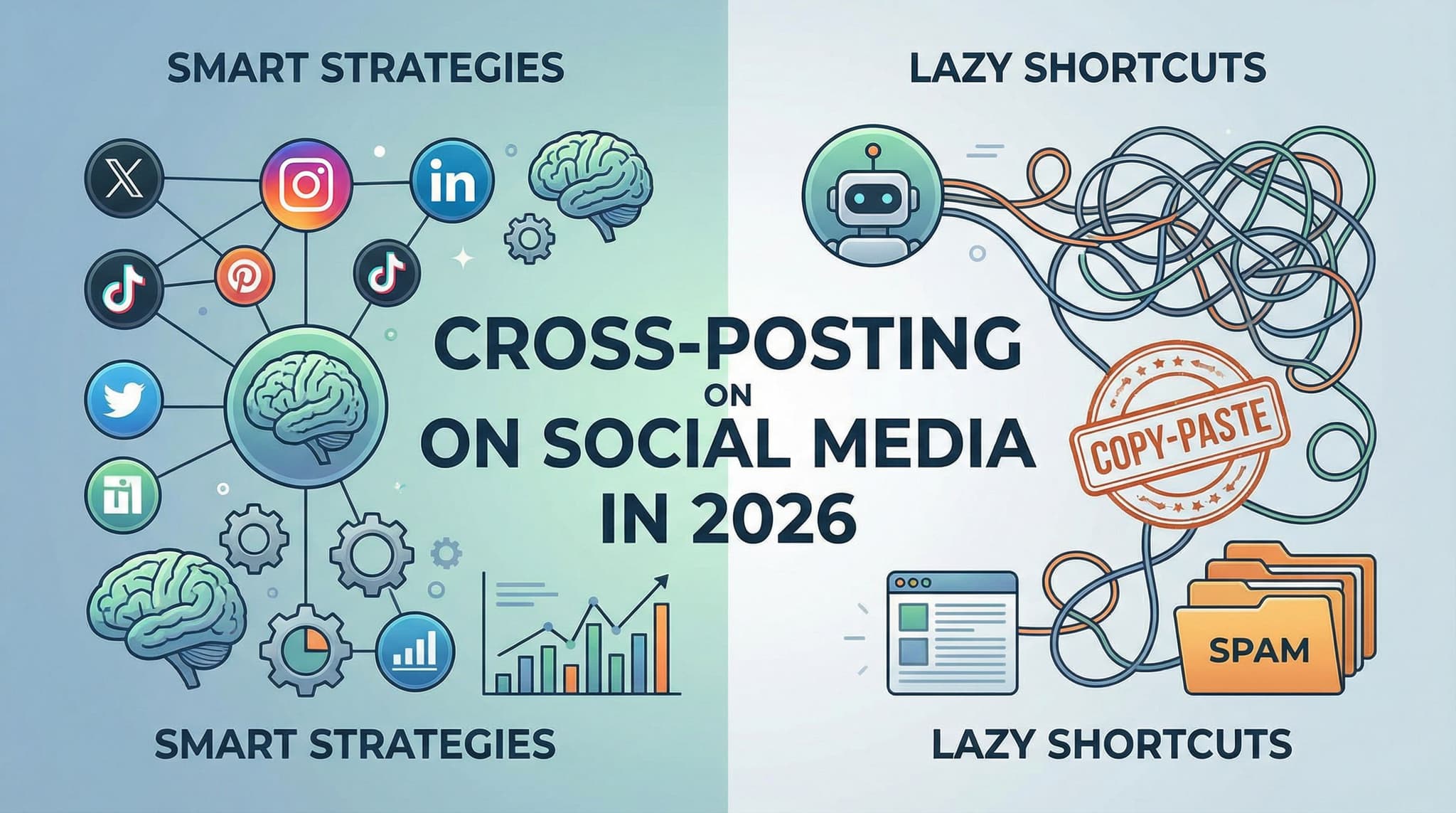
Cross-Posting on Social Media in 2026: Smart Strategies vs. Lazy Shortcuts for Beginners
Cross-posting sounds like a dream solution for busy entrepreneurs: post once, reach everywhere. But here's the uncomfortable truth that most social media guides won't tell you—dumping identical content across LinkedIn, Instagram, TikTok, and Twitter is a fast track to mediocre engagement and wasted potential. In this practical guide, we'll walk you through the difference between smart cross-posting (strategic, customized, efficient) and lazy cross-posting (one-size-fits-all disaster), complete with platform-specific templates, real-world examples, and a decision matrix to help you determine which content actually deserves to be cross-posted.
Jan 31, 2026
Read more
Social Media Storytelling: A Beginner's Guide to Captivating Your Audience in 2026
Discover how to master social media storytelling without expensive tools or years of experience. This comprehensive guide walks you through emotional-first storytelling techniques, platform-specific strategies, and actionable frameworks that turn ordinary posts into audience connections. Learn the psychology behind why stories work, get platform-specific templates for Instagram, TikTok, LinkedIn, and Facebook, and uncover the real secrets small business owners are using to build loyal communities. Perfect for entrepreneurs, content creators, and social media managers ready to tell stories that actually matter.
Feb 1, 2026
Read moreReady to never miss a post again?
Tell Aidelly what to post. It drafts, schedules, and publishes across 9 platforms while you focus on your business.